

The Venice Biennale opens on May 9. The National Pavilion of Ukraine will present “Security Guarantees” – an exhibition by Zhanna Kadyrova curated by Ksenia Malykh and Leonid Marushchak.
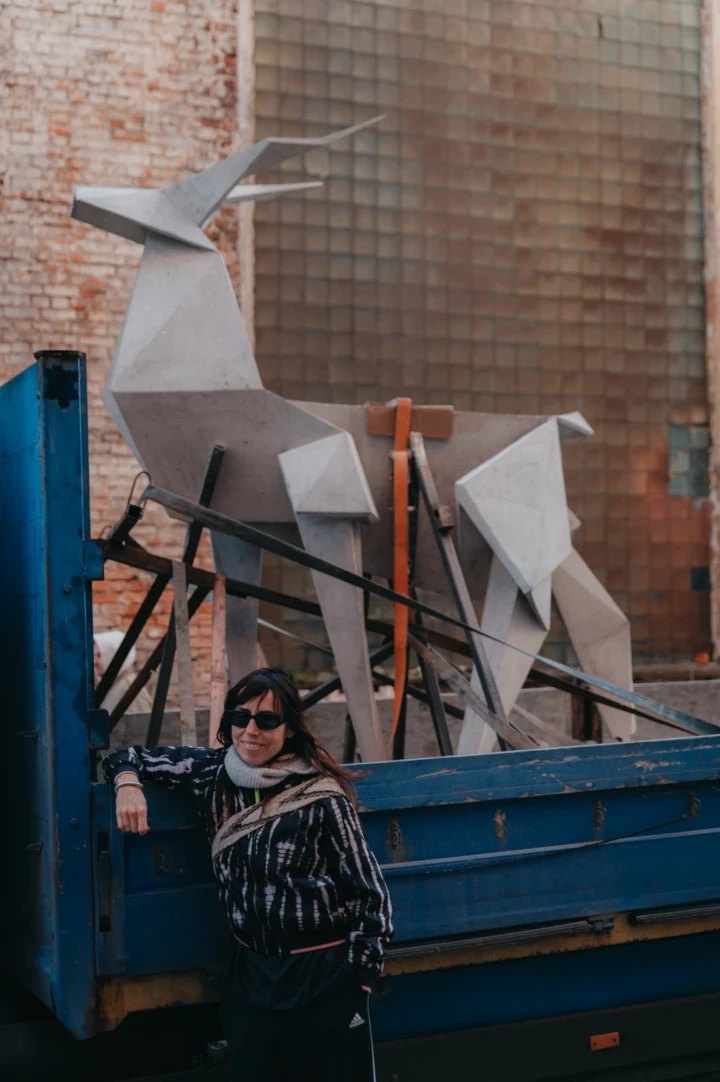
Just outside the entrance to the Giardini della Biennale — the Biennale Gardens, one of the two main venues of the Venice Biennale — viewers will see a sculpture by Zhanna Kadyrova: a deer suspended from a truck crane. The artist created “Origami Deer” in 2019 for the Yubileyny Park in Pokrovsk. The sculpture survived evacuation when the front approached the city, traveled the world, and finally arrived in Venice.
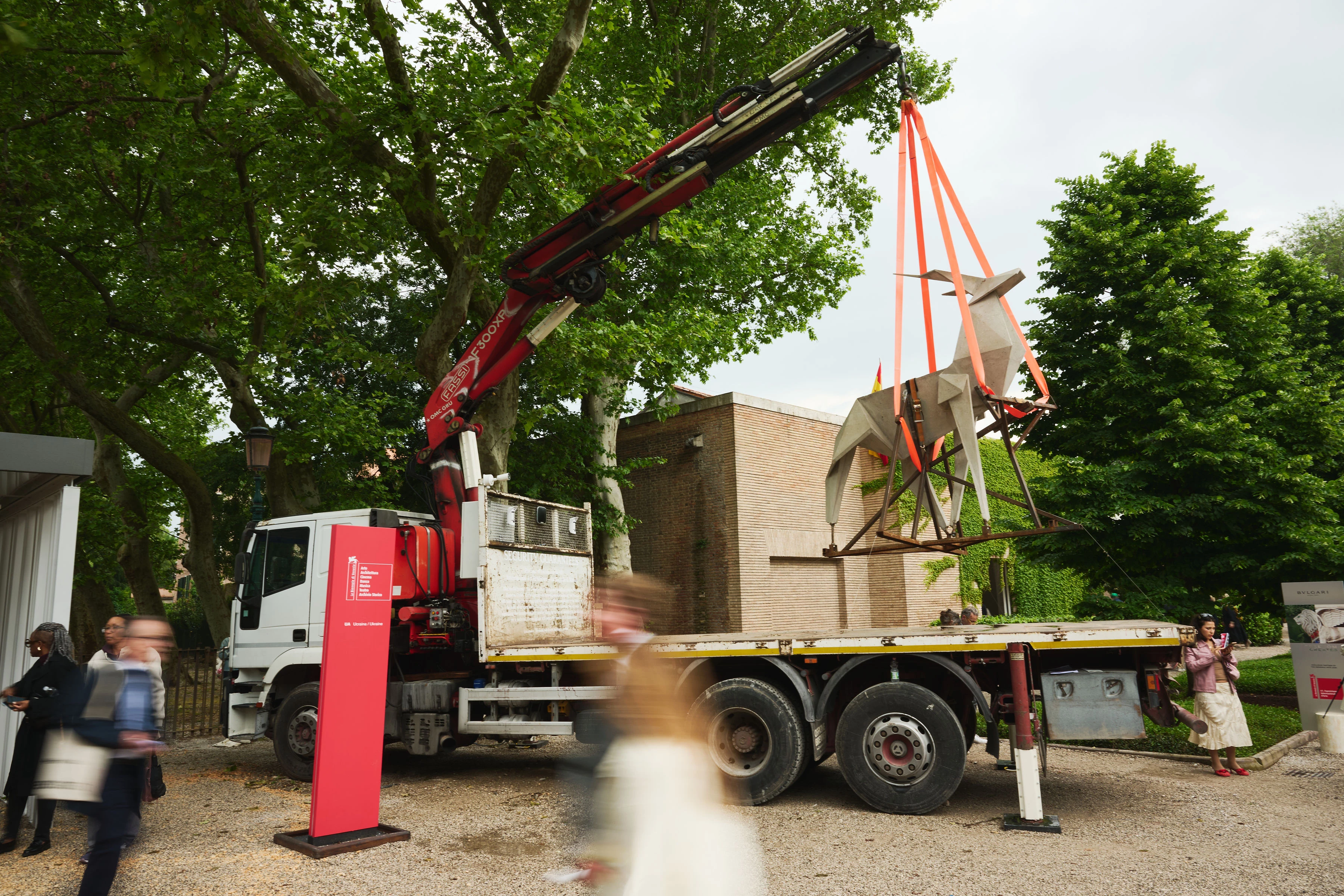
The project will be shown in two locations: the sculpture will be exhibited in the Giardini della Biennale – suspended from a truck crane. The second part of the exhibition will be presented in the Ukrainian Pavilion in the Arsenale. There, archival materials related to the Budapest Memorandum will be shown, as well as video documentation of the sculpture's evacuation and its journey to Venice.
The curators — art historian, program director of Promprylad Art Center Ksenia Malykh and head of the NGO “Museum Open for Renovation” Leonid Marushchak — talk about the project.
What is the story of the appearance of the deer in Pokrovsk? How did it happen that a modern sculpture appeared in the local park on the site of a Soviet jet plane?
Advertising.
Leonid Marushchak: In the post-Maidan period, great attention was paid to the culture of the eastern regions. At that time, the Ministry of Ecology initiated the reconstruction of a number of parks in the Donetsk and Luhansk regions. One of them was the Yuvileyny Park in Pokrovsk. The ministry hired a contractor to reconstruct the park, who was a friend of Zhanna Kadyrova's sister. She approached the artist with a proposal to create a sculpture for a public space.
At first, Zhanna proposed another work for the park – a bicycle parking in the form of a large notebook with the inscriptions: “one cubic meter of gas costs this much”, “one euro – this much”, “gasoline – this much”. It was also implemented. Later, the contractors drew attention to the empty pedestal in the park. It had been standing empty since 2015 – previously a Soviet Su-7 aircraft was installed there. Then Zhanna, together with her partner Denis Ruban, proposed creating a completely neutral sculpture on this site – an origami-style deer.
How did the townspeople react to the Pokrovskaya deer?
Leonid Marushchak: It is interesting that the deer is constantly acquiring new and new meanings. It has already gone beyond the Pokrovsky halo of influence and Ukraine. As for the reaction of the locals, our NGO “Museum Open for Renovation” and I often came at the time when Zhanna and Denis were finalizing the sculpture. We talked a lot with local museum workers: “You have the most famous artist in the country doing a project now – go, document it, take sketches!” But local museum workers were very calm about it.
In fact, the “Origami Deer” began to acquire special meanings only from the moment of its forced displacement and wanderings around the world. It is precisely these wanderings that give it the meaning of a legendary migrant.
Ksenia Malikh: This sculpture was created specifically for public space. It is not in the space of contemporary art, and this immediately removes many prejudices. Zhanna is very successful and suits works in public space, because she knows how to work with the upper layer of perception. It is important for her what people will feel. The “Origami Deer” became a symbol of the city – people said: “Let's meet at the deer”, they liked to take photos at graduation near it. From the point of view of artistic communications, it is very democratic.
What was the greatest difficulty in evacuating him from the city in 2024, when the front approached Pokrovsk?
Leonid Marushchak: The story of the evacuation is very emotional for me. By that time, our public organization “Museum Open for Repair” had already removed most of the exhibits from local museums. During one of such visits, just driving by, I realized that the deer was still standing in place. We had simply forgotten about it!
I call Zhanna: “Zhanna, what are we going to do?” “What can I do?” says Zhanna.
We went to the museum, and they said: we don’t have the right to evacuate… We went to the city administration, but, frankly, they didn’t care — at that time, a mass evacuation of people and material values was taking place in the city. The city authorities didn’t even have the opportunity to issue documents for evacuation, that is, they physically couldn’t prepare this package of documents. We came there four times to somehow get the process started. We couldn’t find a crane for a long time — we needed the city to provide the only working crane in the city. Well, when we arrived, we had only four hours to do everything — because at 11 a.m. curfew in Pokrovsk ended, and at 3 p.m. it began. All utility services could only work until 3 p.m.
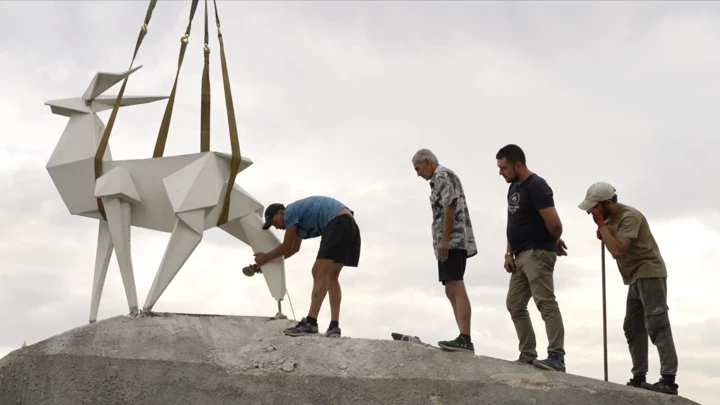
Well, the biggest problem was that the deer was cast on a pedestal. So, unfortunately, we actually left part of the sculpture in place, because it was the base of the monument.
The moment of “dismemberment” led to the fact that the sculpture became unstable. We cannot simply put it somewhere – it needs to be placed in a suspended state, and this is an additional metaphor. On August 31, we managed to transport the deer from Pokrovsk to Vinnytsia, and then its journey around the world began.
Did you immediately understand that you would exhibit the deer in Venice in a suspended state?
Ksenia Malikh: Yes, the sculpture is exhibited in the Giardini della Biennale on a truck crane. Our displaced person hanging on a crane in Venice is a very metaphorical story. The suspended state symbolizes the uncertainty familiar to Ukrainians today. As for the National Pavilion, in the Arsenal we have a video installation that shows the story of the deer's journey from Pokrovsk to European capitals and the moment of its entry into Venice.
Before the Venice Biennale, you managed to show the deer in six European capitals. How is the world reacting to it?
Ksenia Malykh: It was important for us to show it not in public space, but in influential art institutions. The idea was to make this path to Venice visible. In each place, in addition to the presentation of the film and the project, we held lectures and public discussions with the involvement of local experts. This created a very dense intellectual space around this sculpture. In Venice, the deer will already be familiar to many.
The topic you raise in Zhanna's project, “Security Guarantees,” is both political and historical at the same time. To what extent have you managed to explain to the European audience why the Ukrainian pavilion today talks about the Budapest Memorandum?
Leonid Marushchak: When we finalized the concept of the National Pavilion and began communicating it to the outside world, we realized that many people in the world did not know what the Budapest Memorandum was. After its signing in the 1990s, little was said about it — the world simply sighed, because three countries renounced nuclear weapons. After that, no one particularly returned to this topic. We live with this, understanding the danger. So in the context of the deer's wanderings through Europe, we wanted to remind you: there is such a topic, and we live with a sense of this danger.
Ksenia Malikh: Regarding the reflection of those who participate in our discussions, there was a lot of talk about nuclear blackmail. In Europe, this topic is well perceived in this context, because everyone understands that Russia is doing this right now. We also talk a lot about the security situation in Europe – this topic also worries many. Plus topics related to ecology, climate justice, the Anthropocene. I think this will continue to develop within the framework of our program in Venice in the fall.
Leonid Marushchak: In the pavilion, we also raise other topics — in particular, the topic of forced displacement. We also talk about the concept of cultural heritage and the fragility of contemporary art. Zhanna's sculpture was lucky, but how many such sculptures are left throughout Ukraine that we could not save?..
When we talk about emergencies and sculptures in public spaces, our country has no procedure for determining what is valuable and what is not, what needs to be preserved and evacuated. Often this art is doomed. And not only sculptures – we can recall the house of Polina Rayko in the Kherson region, which suffered after the disaster at the Kakhovka hydroelectric power station. How many such things have we not managed to save? Of course, in war conditions, human life is the first priority, then material values, and only then public art.