

In the “Heroes” project, Vogue Ukraine honors military personnel, doctors, artists, energy workers, paratroopers – fallen and living – heroes who, with their daily work, help the country survive in the darkest times. The first hero is musician and volunteer Svyatoslav Vakarchuk, who in an interview with Ukrainian Vogue frankly talks about the most heartbreaking performances in his life that took place at the front, his own fears and love.
Advertising.
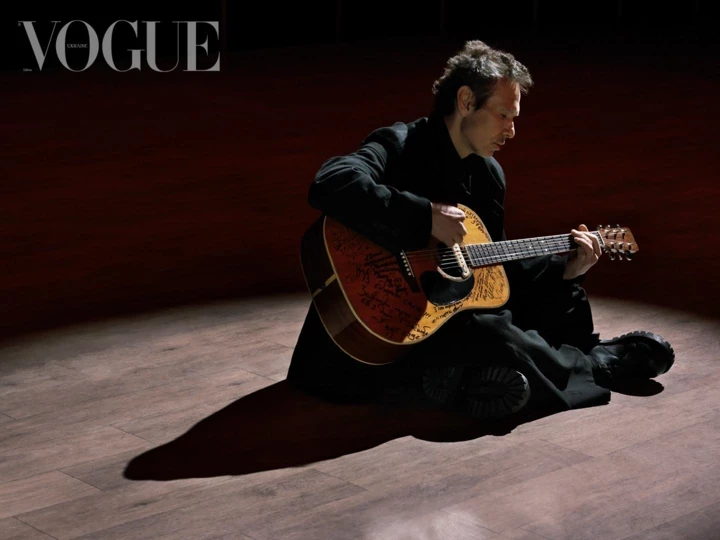
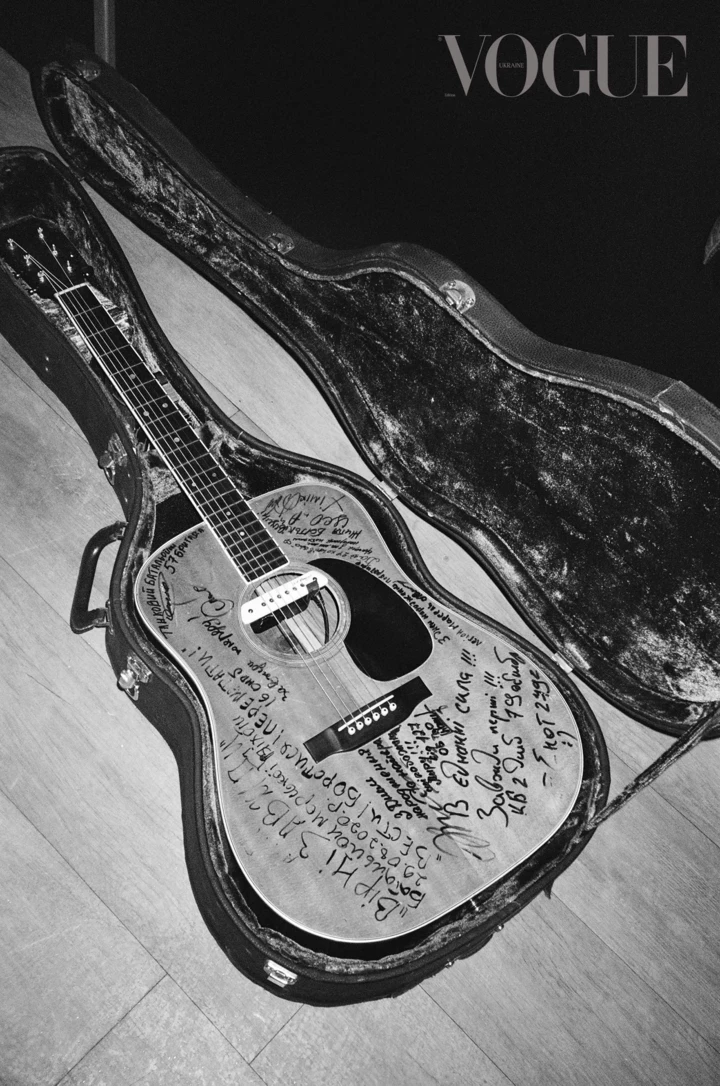
Sviatoslav Vakarchuk shows off a guitar painted by Ukrainian soldiers with childlike enthusiasm: autographs, warm wishes, funny drawings. Sviatoslav bought the 1969 collectible instrument from a friend who bought it at an auction in America. The frontman of the band “Okean Elzy” says that world legends have played it: “Maybe even Paul McCartney.” Since then, he has traveled with this guitar to dozens of front-line cities and positions – from Avdiivka and Sloviansk to Zaporizhia. He played for soldiers in trenches and hospitals, in abandoned houses and at gas stations – and now he improvises in a frame for Ukrainian Vogue, sitting on the cold floor of the music club The Origin Stage in the center of Kyiv.
This is one of two guitars owned by 50-year-old Vakarchuk. There was a third one, which went to auction last winter for $350,000: the funds were used to purchase drones and electronic warfare systems for the 1st Corps of the Azov National Guard. I ask if he is ready to sell this collectible instrument — obviously very valuable to him — to help the army. The musician pauses: he is ready — for a million dollars. “Let's write about it. Maybe someone will be interested?” he laughs.
For 30 years, Svyatoslav Vakarchuk has been the leader of the country's most popular band. “Okean Elzy” is a record-breaking band. After three sold-out performances at the capital's “Olympic” in 2014, 2016, and 2018 – 75 thousand people each time – in May 2019, a performance at VDNH gathered 100 thousand fans. No other artist has yet managed to overcome this benchmark. But when I ask which performance was the most heartbreaking for him, he recalls last year's front-line concert in a small store in the backwoods on Pokrovsky Street: “Then the military offered to go to a “quiet, safe place.” We drive up – and it's an ordinary grocery store. Inside there are a lot of people, fighters – and I just sang among those counters with chocolates.”
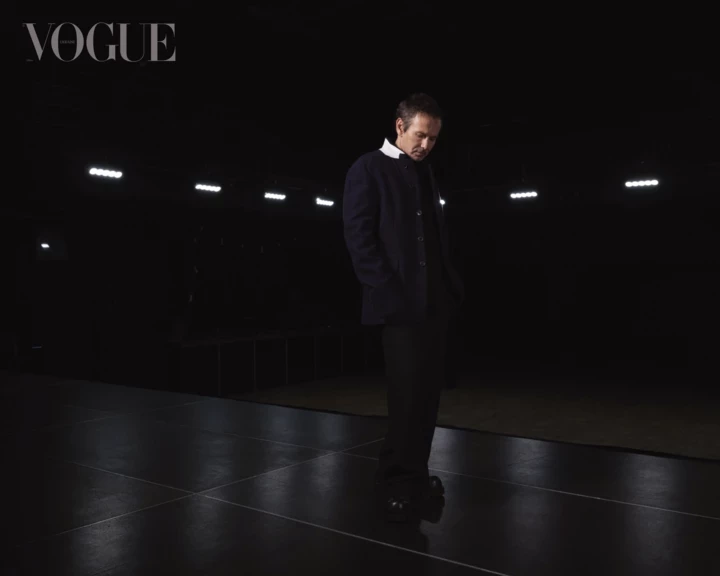
We are sitting in the dark, cold dressing room of The Origin Stage, the musician is wrapped in a coat. Just yesterday he played at the positions of “Charter” in the Kharkiv region, and tomorrow he is going to Berlin – to the presentation of a documentary dedicated to the 30th anniversary of the band. “Okean Elzy” is known for playing concerts both at the main venues of the country and the world, and in places that are absolutely not adapted for this. On February 22, 2022, Svyatoslav and his team – guitarist Denis Dudok and keyboardist Milosh Yelich – went out onto the pedestrian bridge in Kyiv to sing “Everything Will Be Fine” and other hits. In the days when news was spreading about a possible full-scale Russian attack on Ukraine, we wanted to show: “we are here, we are at home.” Within a week, Vakarchuk was in Kharkiv: he sang “Chervona Ruta” in the subway and on Maidan Svobody, where a Russian missile had hit the day before, and went on live broadcasts of world channels directly from his phone to show what was happening live. In a bulletproof vest, with sunken eyes, confused. He recalls: “I saw that the front was near Kharkiv, and I just knew that I had to be there.”
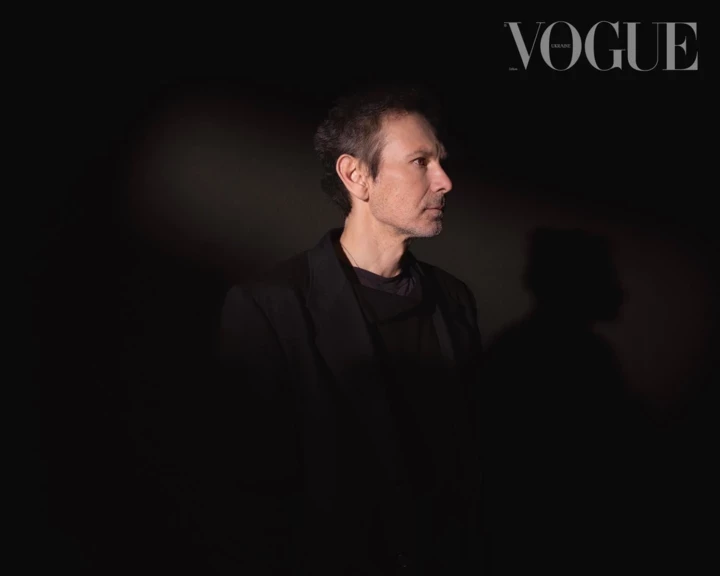
Vakarchuk grew up in Lviv in an academic environment: his father was a prominent physicist, rector of Lviv University, later the Minister of Education; his mother was an educator, now an artist. He was raised on the music of The Beatles and The Rolling Stones, and since 1994 he has been a vocalist, leader of “Okeanu Elzy” and the author of most of its songs; and although he was never involved in the army, he says that now this world is as close to him as the musical one.
In the summer of 2014, he and his band first performed for the military in Mykolaiv. Then there were concerts in Pisky, Maryinka, Avdiivka, Sloviansk, Severodonetsk, and Lysychansk, and since 2022, his routes have run along the entire front line. Without posters and stage grandeur, these are chamber performances for soldiers and concrete volunteer support where it is needed most. Over four years of full-scale war, “Ocean Elzy” has helped raise over 355 million hryvnias for the troops, in particular for the Defense Forces, mainly for the purchase of drones and electronic warfare systems, communications equipment, and ambulances. The band's popularity works wonders: five anniversary concerts in the Kyiv Palace of Sports the year before last brought over 10.5 million hryvnias for the needs of the Defense Forces, and four big shows in Lviv last summer brought seven million hryvnias for the Defense Forces.
The war made me less categorical. Today I avoid conflicts and arguments because I understand: Ukrainians are the way they are, I have no others.
The musician says: for soldiers who have just left their positions and lost their comrades, music works best, not words. “I was in the positions of one of the units of the 80th brigade from Lviv, near the village of Borova in the Izyum region. The day before, there had been a battle – with losses. We started talking, talked for a long time, and then one of the soldiers asked: maybe you'd like to sing something? I took the guitar, started with “On the day we become ourselves”, then “Hugs”, then “I'm going home”. At the end, they even started to smile.”
Over the past four years, Okean Elzy has released two albums: the Ukrainian “That Day” and the English-language “Lighthouse.” Vakarchuk calls “That Day” “light and genuine.” It includes the songs “Mukachevo” about the artist's hometown, “Mama!” about the dearest person, and the sensual “Schiele” — of course, about love. It seems like a bold move to write about the intimate during a full-scale war. For him, it's not a gesture, but a natural way to speak to the listener: “Music is the most abstract art. If you're a writer or a poet, you've written about war, and people see that it's about war. And in music, you have the luxury of not telling people what to feel — they'll decide for themselves.”
Vakarchuk is not a fan of writing for the sake of the day and does not want to be part of the conjuncture. He only created a song to order once – for the fighters of “Azov”. This is the track “Misto Mariai”, which was released in mid-April 2022, when Mariupol was under Russian siege. “Then Kalyna (Sviatoslav Palamar, deputy commander of the unit. — Ed. note), who was surrounded at Azovstal, contacted me and asked me to write a song about Mariupol to support them. I was struck that at such a moment the military were thinking about music. Somewhere in a post by one of the volunteers, I came across the expression “Mary's city”. It was such a strong image — a city that gives life. I was driving to Lviv when I received that call. At night, I got to the hotel, took my guitar and around six in the morning, at dawn, I wrote the lines: “And the sun rose over Azov””.

The country's most famous band celebrated its 30th anniversary in 2024. By the anniversary, the team released its tenth studio album “That Day”, a documentary film and a photo book by Arthuss Publishing House, and also played nine large-scale concerts in Kyiv and Lviv and several dozen abroad – from North America to Israel. Describing a professional path spanning more than three decades, Vakarchuk primarily talks about sensual things: “We do this because we can't help but do it. There is no goal in music – we just create, it's our way of living life.”
He says that creativity, family, and trips to the front are the three pillars on which his psyche rests. “Everything else is like everyone else's, basic things: friends, some pleasant shopping, and lots of sports. I have to do something with my body every day: I get up at six and, wherever I am, do some exercises.” Before the full-scale invasion, he read a lot – it helped to organize his thoughts. Now – less. “I literally force myself to read. If before the war I read one book a week, now – God willing, one a month.” Among the last things he read and reread are “The City” by Valerian Pidmogilny, novels by Thomas Mann, Julio Cortázar, Gabriel Garcia Marquez, and Joseph Roth.
Musician says: Music works best for soldiers who have just left positions and lost comrades, not words
Has the war changed him? Vakarchuk says he would like to answer in a few years. “There is a lot of stress now, an excess of cortisol and adrenaline. We do not reflect, but react – everything is reactive for us.” He admits that he has become more responsible and anxious, but he still writes a lot – music and songs “about love, war and about love during war.” In 2021, Svyatoslav and producer Yevheniya Yatsuta had a son, Ivan, and in the summer of 2022, a daughter, Solomiya.
“The war made me less categorical,” the musician concludes. “Today I avoid conflicts and arguments because I understand: Ukrainians are the way they are, I have no others. We shouldn't fight with each other over trifles. Being a human being, hearing each other, is much more difficult than playing the piano or writing songs. You learn this all your life.”
Photo: Ira Lupu
Style: Sonya Soltes
Hair and grooming: Daria Zhadan
Producer: Mariia Nikolaienko
Lighting: Michael Aziabin
Stylist Assistant: Yuliia Ostapchuk
Project curator: Alyona Ponomarenko
Thanks – Origin Stage