

Director Tonya Noyabrova, known for the film “Do You Love Me?”, has made a documentary film “Spring-Summer” dedicated to the Ukrainian fashion industry. In a conversation with film critic Elizaveta Sushko, Tonya talks about how she and the team chose the characters for the film, about her friendship with the designers, and why she refused to show the war literally.
“Spring-Summer” combines personal stories, archival footage and backstage filming. In particular, the viewer will see an exclusive backstage of the FROLOV fall-winter 2025 show, the archives of Litkovska, Bevza, Anna October, Ukrainian Fashion Week, TSUM, as well as unique footage from the 1990s production. The premiere of the film, which was released by the SKVOT pop culture school, took place at the Zhovten cinema in the capital on March 25. The film “Spring-Summer” can already be watched on YouTube.
Advertising.
Tonya, I was surprised that the idea to make a film about fashion did not belong to you, but you joined SKVOT when there was both a concept and a name. I had a feeling that it all started with you, because in all your films a lot of attention is paid to clothes. I remember well how long you can talk about jackets from the 1990s in the film “Do You Love Me?”. What is your relationship with fashion?
I know how to dress, but I can also create an image from some trash. Clothes are not a fundamental issue for me. Although it probably doesn't seem like it. Everyone thinks I'm a fashionista, but buying an expensive bag is not about me. I'll take a bag and carry my cucumbers home.
At the premiere, you and the production team mentioned that you chose heroes and heroines who already have some influence in Ukraine and abroad. Tell us how you decided on the final cast. Perhaps there was someone who was the most difficult to agree on?
I am friends with many designers. They visit me, we are friends and love each other. But Ruslan Baginskyi almost never gives interviews, no one knows the voice of Yulia Pelipas. So I wrote to everyone personally and invited them.
I talked to everyone — it was a friendly conversation, I didn't even prepare questions. It's important for me to talk to a person, hear them, feel them. I knew where I wanted to take the story, and I was lucky — I know the inner workings of brands.
That's why this phenomenon of sincerity happened: I knew what I was asking about, I saw how they created fashion during the war and what path they went through. For example, I have known Lilya Litkovska, Lilya Pustovit, Iryna Danylevska for 25 years — although I am 26.
In the end, how did you persuade Ruslan Baginsky?
It was really difficult with Ruslan and Petro, because it happened at a time when they were designing Galeries Lafayette in Paris — that's what the film is about. And they were fully involved in the process. Plus, they had an NDA — they couldn't say they were designing the main windows of the French capital.
So I didn't get any explanation from them why they didn't agree. It was a family scandal between us.
I met them at all the events — and it seems they were hiding from me for a while. And only thanks to my persistence, after six months we got them on “Viriya”. I remember this moment very well — literally frame by frame. We met by chance, and I said: “Petro, we've almost edited the film — it was August — give me an interview, my heart hurts all this time that you're not in it.”
And he turns to Ruslan and says: “Maybe we should give an interview?” To which Ruslan agrees. And so it happened.
Are there those who did not want to give interviews and whom you could not persuade through persistence?
Ivan Frolov did not agree to an interview, there were personal reasons for this. But he helped the project a lot, gave all the materials, we filmed his screening. He is presented in a great way in the film.
You filmed abroad, visiting some designers…
I didn't go to optimize the budget, but it was critically important for me to film there. Because all the designers invited us to their homes — we filmed at Yulia Pelipas's home in London, at Svitlana Bevza's office in Paris, and at the Schneiders' in London. They literally let us into their lives.
You are filming Katya Silchenko right at the production. This is generally very sacred for many designers.
Moreover, I had a very interesting and funny story with GUNIA. They have three production lines — ceramics, textiles, and jewelry. I wasn't very interested in showing them how they make dishes, so I asked the girls to open their chests for me. Because I know that they buy vintage and antique towels — I've seen them in private, and they're phenomenal. And I insisted on showing it on camera. And they revealed to me something they didn't show anyone else.
Among the poignant, very intimate moments is the one when Liliya Litkovska opens a letter that she took from her screening. A letter with a poem by Lina Kostenko from a random person who wrote it “for a Ukrainian woman.” Tell us how you managed to film it?
During the interview, Liliya told a story about her show in Paris, where guests wrote letters to Ukrainians. She said that she took one letter and kept it, but she hasn't opened it yet – she will do so after the victory.
The interview is over, I'm driving to the next location and I remember this moment. I'm sitting in the car with the cameraman, dialing Lilya, asking where the letter is. It turns out it's in Paris. I begged her to open it for me on camera. No one knew what was written there.
She agreed. I arranged for the camera — and when she opens it, she starts crying. It’s a remarkable moment. We were all crying: I was online, the cameraman was also in tears.
Half a year of editing has passed, I'm reviewing the materials, looking for some little thing – and suddenly I see who wrote this letter. Anastasia Boshko, our mutual friend. I take a screenshot. It turns out that it was really her in Paris, and Lilya accidentally took her letter. And with the words of Lina Kostenko. Since then, everyone has been crying.
This moment is incredible. But you can feel that the words in the letter resonate with Lilia — on a personal and professional level.
Because it's true: Lilia is a pioneer of the fashion industry. Katya Silchenko once dreamed of getting to Litkovskaya's show. And she dreamed of getting to Pustovit's show, which was impossible to get into at all. When Ukrainian Fashion Week began, Lilia Pustovit always opened the shows. And despite the fact that my dad was a star at that time, even Ilya Noyabrov, the country's main TV presenter, couldn't get us tickets to her show. It was for the chosen ones.
I wonder how you show the beginning of a full-scale invasion in the film. In a bunch of documentaries, I've seen the same technique so many times — the air raid siren goes off, a voiceover from the news, and stock videos from February 24. Often, they're all the same. You made a simple but logical gesture with the Central Department Store — why?
I knew that I didn't want to show war in this film – everyone shows it that way anyway. We live in this: I'm in Kyiv, there's anxiety every day, now there's no light at home. And it was important to me to show war without war.
That's why I knew exactly the emotion – there will be no explosions, no war footage. Because the drains you're talking about are crutches: show refugees, the same footage as everyone else, and it will be “nice.”
We took our own photos, even asked the Central Department Store to turn off the lights. And I'm grateful to myself that I didn't go down to the drains and follow the beaten path.
What would you not give up in this project? You gave up a trip to Paris, but what would you never give up?
The leitmotif. Because this film is not about fashion. It is about an internal question: why do I stay in this country? Why do I want to continue living in it?
And it was important to me to give people a basis so that they could speak and rejoice that they are Ukrainians. To, as Ruslan Baginsky said in the film, give them inspiration for life. That's something I could never give up.
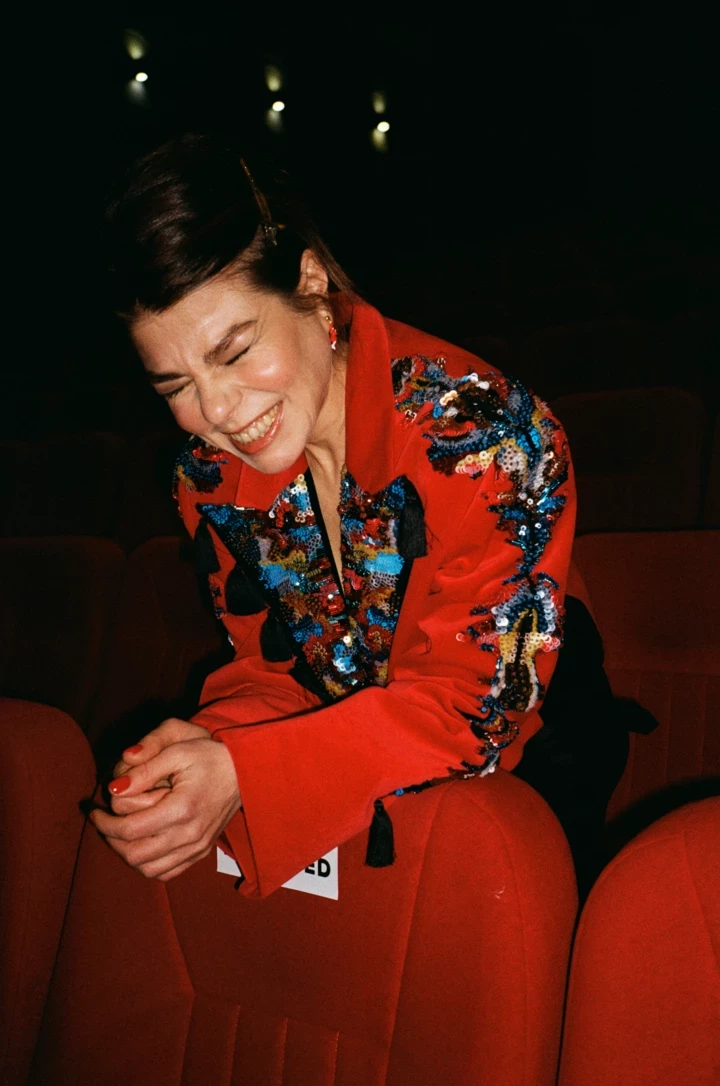
We talked about designers. Why Iryna Danylevska is in the film is also clear. How did you choose other heroines from our stars — Nadya Dorofeeva and Jamala? Why do they talk about their experience of working with designers?
Because they are absolute fans of Ukrainian design. And I really wanted to get comments from people for whom it is not just a matter of use, but something that affects life and work. I remember well how we chose clothes for Eurovision and when Nadya was preparing a concert at the Palace of Sports. And I know that they are truly ambassadors of Ukrainian designers.
Have you considered bringing in any foreign stars to commentate?
We didn't have that idea, because we wanted to talk about Ukrainian fashion from the perspective of Ukrainians.
There are several moments in the film with archival materials — a Soviet-era Central Department Store, an interview from the same era with a girl who was detained because she went to Poland to buy shoes, and your favorite clothes market from the movie “Do You Love Me?”. When did the archives appear and why?
The fragment from the girl's interview was probably the very first material in the editing. Our editor Nastya Tymus found it. And we bought it from Suspilny. This is a real archive, and this fragment cost us either 30 or 40 thousand hryvnias. This is the most expensive episode in our film.
You edited for 200 days. Have you analyzed today, when the film is already finished and has a life of its own, why it took so long and so hard?
Editing was extremely difficult. But despite everything, it was an incredible journey full of love. I don't know if I will return to documentary filmmaking anytime soon, let's talk about it in a few years
Photo : Nikita Zhuravlev