

 Share
Share
As in recent years, only one woman is in the running for the Oscar for Best Director in 2026 – two-time winner Chloe Zhao for the film “Hamnet”. In total, in the entire history of the award, only three women have won the statuette for directing: Kathryn Bigelow (“The Tempest Lord”, 2010), Chloe Zhao (“The Land of Nomads”, 2021) and Jane Campion (“In the Hands of a Dog”, 2022).
There are many reasons for this. One of the main ones is that the Academy's directorial branch, which determines the nominees, is still predominantly male and has historically often ignored the work of women. Until that changes, it's especially important to watch and support films directed by women. So here are five films by women that definitely deserve more attention this awards season.
Advertising.
“Voice of Hind Rajab”
Director Kawther Ben Haniya’s poignant docudrama is a cinematic marvel. It’s a meticulously crafted account of the life of six-year-old Palestinian girl Hind Rajab, who was trapped in a car under fire in northern Gaza in January 2024. The story is told through the eyes of the Palestinian Red Crescent volunteers in Ramallah who received her call for help a few miles from the scene of the tragedy. The film stars Saja Kilani, Motaz Malhis, Amer Khlel, and Clara Khoury, and they play them masterfully. The film follows their desperate attempts to save the girl step by step.
Fortunately, Tunisia, the director's home country, nominated the film in the Best International Feature category, where it was nominated. This is a great achievement, as not everyone in Hollywood is ready to talk about the Palestinian tragedy, and the film even had problems with distribution in the United States at first.
A win would be great, but honestly, it's a shame that the film was ignored in the Best Picture and Best Director categories, as it's truly impressive in its scale and emotional power. If you only watch one film this awards season, make it this one.
“I am not iron”
It's a chaotic, nervous, and utterly uncompromising exploration of motherhood, the story of a woman struggling to care for her terminally ill daughter. Rose Byrne gives perhaps the best performance of her career. Director Mary Bronstein films the actress in tense close-ups, her face constantly shifting from rage to fear, from shock to painful humor.
The film received mixed reviews after its Sundance premiere. Many considered it too intimate, but the film proved otherwise: Byrne received a Golden Globe, an Independent Spirit Award, and an Oscar nomination for Best Actress. Although Jessie Buckley (Hamnet) is considered the Oscar favorite, Byrne still has a chance. At the same time, her brilliant performance largely rests on Bronstein's sharp script and bold direction – which also deserve much more recognition.
“Anne Lee's Testament”
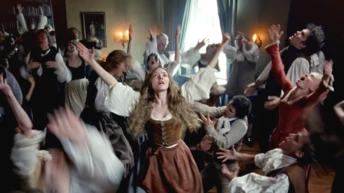
Mona Fastvold's expansive, ambitious, and literally music-drenched film tells the story of Anne Lee, founder of the Shaker religious movement. The film takes us from 18th-century Manchester to a creaking ship and then to the New World, where the heroine leads her followers to a new life. It's an almost hallucinogenic whirlwind of folk songs and passionate dances. Yes, not everything works perfectly here. But the same can be said of the director's previous film, “The Brutalist,” which she wrote with her partner Brady Corbett. The irony is that this film – a fictional biopic about a “great man” – received 10 Oscar nominations and won three.
And a film about a real woman who achieved incredible things? Zero nominations. According to many critics, the film definitely deserved a place on the shortlist for “Best Picture”. And this is not the only injustice: Amanda Seyfried in the lead role demonstrates true acting virtuosity, but she was also bypassed by nominations. Add to this the luxurious costumes, precise set design, Daniel Bloomberg's goosebumps-inducing music, and the directorial talent of Fastwold, who was able to combine all this into a large-scale historical drama with a relatively modest budget. And as is often the case: when such ambitious experiments are made by male directors, they are celebrated. When women do it, they are often ignored.
“Left-handed”
Directed by Shi-Chin Tsou, the film tells the tender story of three women: an exhausted single mother, her rebellious twenty-year-old daughter, and her lively five-year-old sister. They move from the countryside to bustling Taipei to open a small noodle stall in a night market.
Each of them has their own problems and inner demons, but together they try to stay afloat. Taiwan nominated the film in the “Best International Film” category, and it even made the shortlist of 15 films, but did not make it to the final nominations. But that is definitely not a reason to miss it. It is a poignant, warm and extremely lively story about female strength, solidarity and endurance.
“Hedda”
Director Nia DaCosta (“Candyman,” “Marvel”) takes on Henrik Ibsen's classic play “Hedda Gabler” with obvious pleasure, transforming it into a stylish and dynamic film adaptation. The events are transferred to the glamorous 1950s – to a noisy party at the estate of the English aristocracy. The film has four main trump cards: the charismatic Tessa Thompson in the lead role, the brilliant Nina Goss as her former lover, luxurious costumes, and impeccable set design.
Thompson and Goss were nominated for Independent Spirit Awards, and Thompson also won Golden Globes and Gotham Awards. The film was nominated for the Critics' Choice Awards for its costumes. Unfortunately, the Academy Awards passed on the film. However, if you're looking for a bright, stylish historical adventure, this film is definitely worth checking out.