

While the meaning of fast fashion is pretty obvious, with the explanation already embedded in the name, it's only by looking at the clothing industry more broadly that we can understand why it has become so widespread. In its simplest form, “fast fashion” is trendy items that are quickly produced and sold at low prices. But the production and consumption of clothing on the current scale is causing great harm to both the planet and people.
Advertising.
Despite the growing interest of younger generations in sustainability and ethical production, the fast fashion segment continues to grow rapidly in terms of volume and revenue. According to research by CoherentMI, the fast fashion market in the United States alone was estimated to be worth almost $46 billion in 2025, and is projected to reach approximately $68 billion by 2032. This means that the demand for fast-moving trends shows no signs of slowing down, and as a result, more and more clothes will end up in landfills and second-hand markets around the world.
What is fast fashion?
A brand is not classified as fast fashion solely because of its price, specific assortment, or a certain number of collections per year. This definition refers rather to the very model of production, marketing, and sale of clothing.
In the late 19th century, collections were released in two seasons: fall-winter and spring-summer. “The entire industry is based on systems that were formed after the Industrial Revolution. They were designed for large-scale production, which allows you to reduce costs through large volumes. That is why we have to produce a lot to build the right price,” Preeti Gopinath, director of the MFA Textiles program and associate professor at Parsons, tells Vogue. In the 21st century, information about trends gradually became more accessible, as did the demand for them. At the same time, a system of rapid clothing production developed, relying on new technologies at the time, in particular sewing machines. This made it possible to produce and sell more and more clothes.
By the 1990s, trend cycles had accelerated. Brands like Forever21 and Zara were among the pioneers, releasing clothes at a rate of more than 52 “micro-seasons” per year. Now, with social media further accelerating the spread of trends, newer online-only brands like Shein and Temu are producing even faster, using sophisticated algorithms to bring new styles to market in a matter of days. This is sometimes called ultra-fast fashion.
Why is “fast fashion” a controversial phenomenon?
The environmental impact of fast fashion is a complex and multi-layered issue. For example, a report by the United Nations Environment Programme (UNEP) published in March 2023 found that the fashion industry accounts for up to 10% of annual global carbon emissions. In terms of manufacturing, the excessive use of petroleum-based textiles, particularly polyester, means that brands are dependent on fossil fuels to produce new products. According to the Business of Fashion 2023 report, “petroleum-based polyester accounts for around 50 percent of all fiber production.”
“To produce large volumes, brands are choosing the cheapest materials,” says Gopinath. “The problem is the system itself: people buy things for short-term use and then throw them away.” Polyester doesn’t biodegrade naturally. It accumulates in landfills and water, releasing microfibres over time. These end up in water systems. But overproduction is also a problem, whether it’s synthetic fibres like polyester and nylon or natural fibres like cotton. For example, cotton requires a lot of water, fertilisers and pesticides to grow, unless it’s truly organic.
The impact of overproduction and waste
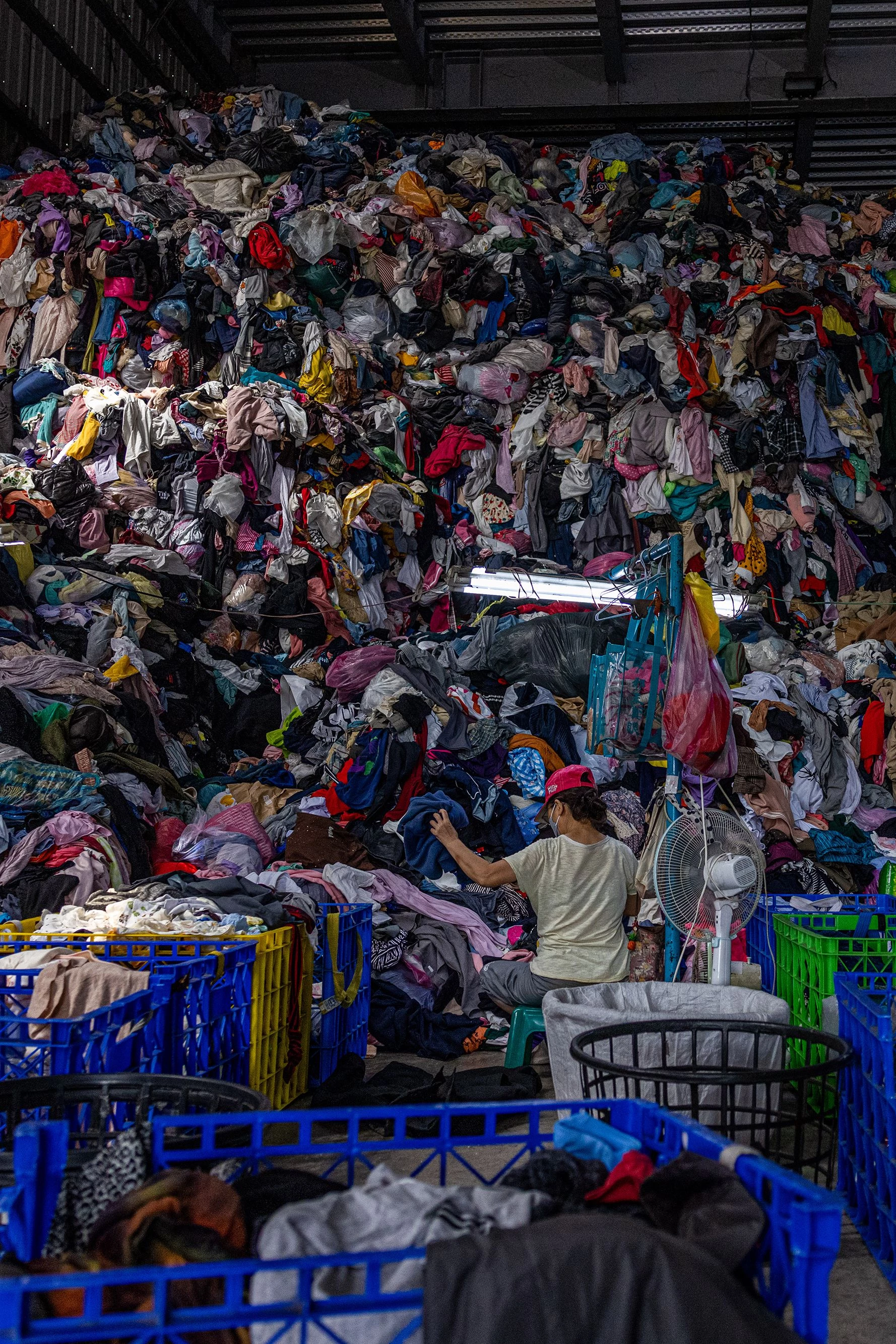
Most modern clothing is designed to fit current trends. Add to that the fact that it is produced as cheaply as possible, and it is no wonder that such clothing is often perceived as disposable. In 2018, the US Environmental Protection Agency (EPA) reported that 11.3 million tonnes of textiles ended up in landfills. What is more, the donation system in countries such as the US and the UK is imperfect. Much of the unwanted clothing that people donate to charities ends up being sold in second-hand markets in countries of the Global South, such as Ghana and Chile. Textiles that cannot be sold there end up in landfills or in the ocean.
“Overproduction is borne by the most vulnerable people in the fast fashion supply chain, who are often in the Global South,” Sammy Oteng, senior community engagement manager at The Or Foundation, tells Vogue. “In Ghana, where I come from, the influx of these clothes is overshadowing the important, culturally rooted work of the Kantamanto market, the world’s largest reuse and upcycling system. It’s also accelerating the decline of the local textile industry and devaluing the quality and sentimental value of clothes in people’s eyes. All of this happens because fast fashion presents clothes as disposable. One way forward is to reduce the volume of clothing production, coupled with globally accountable Extended Producer Responsibility (EPR), which should provide the investment needed to develop local circular economies and rebuild local textile industries.”
Workers' rights
Fast fashion is affordable not only because of the cheap materials used to make it. Historically, workers around the world, 80% of whom are women, have been paid on a piece-rate basis, meaning they are paid by the number of items they produce, rather than by the time they work. This has left their wages extremely low. Under this system, workers receive a very small amount for each unit they produce, meaning they can earn only about $200 for a full week. In Bangladesh, the world’s second-largest exporter of clothing, the minimum monthly wage for workers is just $113.
But the problem is not just about wages. The fashion industry’s supply chain is complex and involves subcontracting to factories around the world. This often means that there is a lack of oversight over the safety of workers. Many have reported gender-based violence, harassment and unsafe conditions in the buildings where they work. In 2013, the Rana Plaza garment factory collapsed in Bangladesh. The tragedy killed 1,134 people. The Bangladesh Accord was created to prevent similar disasters in the future. It is “an independent, legally binding agreement between brands and unions to create a safe and healthy garment and textile industry in Bangladesh.”
What are the solutions to the problem?
1. Legislation.
Over the past decade, and especially since 2020, major laws have been proposed in various countries to change the rules of the game for the fashion industry. In the US, the Fabric Act would ban piecework wages nationwide. In New York, the Fashion Act would require brands to control their supply chain. And another federal bill, the America's Act, would provide $14 billion to develop a circular model for the textile industry.
2. Slow fashion.
Other ways to address the problem involve changing people’s habits and moving towards sustainable practices and “slow fashion.” “Slow fashion is all about making a conscious choice to buy less: shopping thoughtfully and choosing a few high-quality, long-lasting pieces in your wardrobe over less-quality, short-lived trends that you might only wear once,” says George Graham, co-founder and CEO of Wolf & Badger, a retailer that specializes in supporting small designers and sustainable fashion leaders. “By buying less and more consciously, you’ll gradually end up with clothes in your wardrobe that you really love and will wear for years to come.”
Another promising solution to the problem of overproduction is the growth of the second-hand and upcycling market. A recent report by ThredUp states that the global second-hand market is projected to grow to $350 billion by 2028.
Based on material from vogue.co.uk