

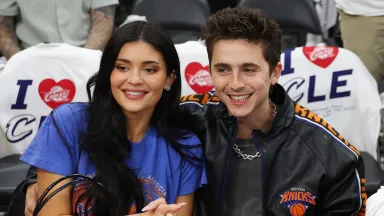
Image Credit: Getty Images
Kylie Jenner encircled Timothée Chalamet’s neck with her arms and planted a kiss on him as the Knicks surged to a 40-point advantage in Cleveland. Unsurprisingly, the internet reacted intensely.
Two of the most scrutinized individuals globally, in perfect harmony, radiating under the stadium lights. She’s glowing. He’s glowing. The Knicks are dominating. The scene is picture-perfect.
And every person glimpsing those images felt that familiar, subtle pang. The one that murmurs: why isn’t mine like that?
Here’s the unspoken truth. What you’re witnessing is genuine. It’s also a transient phase. And the illusion it perpetuates, that the right partner makes love effortless, is precisely the belief that jeopardizes most relationships I encounter professionally.
The Infatuation Stage Profoundly Affects Their Nervous Systems
From my perspective, throughout life, humans are inherently designed for emotional connection. Our nervous systems continuously assess the people closest to us, implicitly asking: Can I depend on you? And: Do I matter to you?
During the initial stages of a relationship, the answer is a constant, exhilarating affirmation.
I liken it to a dance floor for my clients. One person executes a dynamic breakdance. The other mirrors with a flawless moonwalk. Both individuals’ nervous systems immediately conclude they are perfectly matched. That’s the courtside smooch. That’s the embrace around the neck. It’s two attachment styles basking in immediate validation.
The peril isn’t the euphoria. The danger lies in the societal narrative we impose upon it.
We’ve been led to believe that love is a static accomplishment. Find the suitable person, and the connection endures indefinitely. I term this “Proof of Stake” love, where outward appearances and initial compatibility are mistaken for enduring security. It’s the relational equivalent of claiming ownership simply by posting a photo.
The reality is more challenging. People confuse the initial synchronicity with the relationship itself. The true relationship commences when the alignment falters. And it invariably does.
For Kylie and Timothée, that fracturing will occur within what I refer to as the “goldfish bowl.” Every action observed, scrutinized, documented. There’s no private space to navigate a disagreement smoothly. Nowhere to have an imperfect moment and recover before digital copies proliferate.
The Dynamic I Observe in High Performers, Which Accurately Describes Them
Here’s the pattern I witness in my practice nearly every week, particularly among executives, creatives, and public figures. Two highly capable individuals arrive, distressed because they are treating their partnership as a project they are failing.
The very strategies that propelled their careers—their relentless drive, composed demeanor, and capacity to perform under duress—are the exact methods undermining their domestic intimacy.
I describe it as an emotional structure with a Penthouse and a Basement.
One partner resides in the Penthouse. Articulate, energetic, convinced they are carrying the emotional weight. When they perceive a decrease in attention, their nervous system interprets it as an existential threat. They voice complaints. They criticize. They pose the same inquiry repeatedly. I label this individual the “Relentless Lover.” Beneath their frustration lies a desperate yearning for reassurance.
The other partner withdraws to the Basement. To cope with the shame of perceived inadequacy, they become withdrawn, overly analytical, or resort to the silent treatment as their default response. This is the “Reluctant Lover.” Their emotional coolness serves as a defense against the dread of failure.
When these two approaches clash, the couple becomes ensnared in what I call the “Waltz of Pain.” The Relentless Lover seeks connection. The Reluctant Lover pulls away. The pursuit intensifies. The withdrawal deepens. Neither person is inherently flawed. Both are experiencing fear.
And here’s the crucial point. They dedicate considerable time to debating practical matters, communication styles, and past remarks. They have become preeminent authorities on each other’s shortcomings. If a symposium were held on their partner’s flaws, either could deliver the keynote address, complete with supporting evidence.
What they consistently overlook is the underlying emotion: “I fear I am insignificant to you.”
Disconnection Is Not a Flaw. It’s an Expected Outcome.
This is where celebrity gossip often errs. When a well-known couple experiences discord, speculation abounds. He’s problematic. She’s manipulative. They were never a good fit.
My perspective differs. Conflicts arise precisely because the couple holds significant importance for each other. When a partner’s nervous system detects distance, it triggers the same primal fear a child experiences when separated from a guardian. The protests and withdrawals are not driven by malice. They are instinctive survival mechanisms.
There are no antagonists in this dynamic. Simply two individuals experiencing fear within adult bodies, employing the only coping mechanisms available to them.
If you find yourself relating to this article, identifying with either the Penthouse or the Basement persona, I encourage you to take our complimentary relationship assessment to uncover your dominant pattern. Most individuals are surprised by the revelations.
Here’s what genuine security truly entails: “Proof of Work,” not “Proof of Stake.” It’s the demanding, energy-intensive humility of bridging the gap into your partner’s perspective after causing hurt. Love is not the absence of conflict. Love is the consistent, ongoing practice of mending.
To anticipate a relationship’s endurance without friction, especially under public scrutiny, is to fundamentally misunderstand human nature.
What Truly Works When the Harmony Dissolves
If Kylie and Timothée were to seek my counsel two years from now, feeling depleted and aiming to rekindle the Cleveland kiss, my approach wouldn’t be to help them recapture the past. I would guide them to mature within the relationship.
First principle: cease addressing superficial issues. Disputes over schedules, friends, or dinner remarks are almost invariably distractions from deeper attachment anxieties.
Second: shift focus from “The Narrative of the Other” to “The Experience of Self.” Stop being the primary commentator on your partner’s failings. Begin exploring your internal state when conflict arises. The tension in your chest. The prickling behind your eyes. The impulse to depart or escalate.
That physical sensation is the gateway. The narrative about your partner is the diversion.
I employ the mango analogy. High achievers can dissect a mango’s appearance, origin, and nutritional value for extended periods. This is distinct from the candid, vulnerable act of actually savoring its taste. Couples often do this with their emotional pain. They analyze it from every angle to evade experiencing it.
The task is to taste it. To articulate the vulnerable sentiment beneath the criticism. “I’m afraid you no longer desire me.” This is the action that disrupts the cycle of conflict.
The True Significance of The Kiss
The Cleveland kiss is authentic. So is its aftermath. Both are integral to the unfolding narrative.
The couples I most admire are not those who maintained an unbroken spark. They are the ones who rediscovered each other during the most challenging nights, amidst the most difficult circumstances, when no cameras were present. That aspect remains unphotographed.
That is the sole element that endures.
______________________________________________________________________________________________
Figs O’Sullivan, founder of Empathi, and his wife Teale, are couples therapists in San Francisco, esteemed relationship experts for celebrities and Silicon Valley figures, founders of Empathi, and creators of Figlet, an AI relationship coach informed by their clinical practice.