

Image Credit: Courtesy of Netflix
Guillermo del Toro has brought back to life one of literature’s most celebrated creatures in his Netflix film, Frankenstein. Although the narrative of Victor Frankenstein and his creation has been reimagined countless times since Mary Shelley initially released her 1818 Frankenstein novel, Del Toro’s rendition provides a fresh viewpoint that has garnered the interest of both viewers and critics. The director has consistently highlighted that his interpretation of the story is intended not as a standard horror picture but as a more poignant and reflective exploration of the renowned tale.
In anticipation of the movie’s premiere, Del Toro clarified that Shelley’s novel functioned as a core inspiration for the endeavor. “Mary Shelley’s masterpiece is overflowing with questions that ignite brightly in my soul: existential, gentle, fierce, destined questions that ignite only in a youthful mind and only adults and institutions believe they hold the answers to,” he expressed to Netflix’s Tudum, further stating that the book was his “guide” during the film’s creation. Nevertheless, the director desired to re-envision the story in his own distinctive style, adding that he aspired to “reimagine it with a new approach and a distinct emotion.”
In contrast to numerous adaptations of 19th-century classics that heavily emphasize period-specific aesthetics, Del Toro has indicated that he aimed for the movie to evoke a sense of immediacy and authenticity. “When [Shelley] penned Frankenstein, it wasn’t a historical drama. It was a contemporary book, so I didn’t want viewers to perceive a period piece adorned in pastel shades,” he articulated.
Here, Hollywood Life offers a comparison between Del Toro’s movie and Shelley’s original Frankenstein book.
Credit: Ken Woroner/Netflix © 2025.
Victor’s Father in Frankenstein Book vs. the 2025 Movie
Alphonse, Victor’s father, is portrayed as a caring and giving father figure in the book, ultimately passing away from sadness.
Conversely, within the movie, Victor’s father is depicted as an oppressive doctor named Baron Leopold Frankenstein, who harbors a deep resentment for his eldest son and wife, Baroness Claire Frankenstein. Leopold ingrains in Victor the necessity of upholding his lineage as a Frankenstein and molds him to pursue a career as a surgeon.
Victor’s Mother in the Book vs. the Movie
In the book, Victor’s mother is named Caroline, succumbing to scarlet fever. In the movie, the mother assumes the identity of Baroness Claire Frankenstein, meeting a violent demise during childbirth with her second son, William.
Credit: Ken Woroner/Netflix © 2025.
Elizabeth in the Frankenstein Book vs. the Movie
The character of Elizabeth takes on distinct forms in Shelley’s literary work and Del Toro’s cinematic adaptation. Within the book, her designation is Elizabeth Lavenza, a childhood companion of Victor’s, to whom he is betrothed.
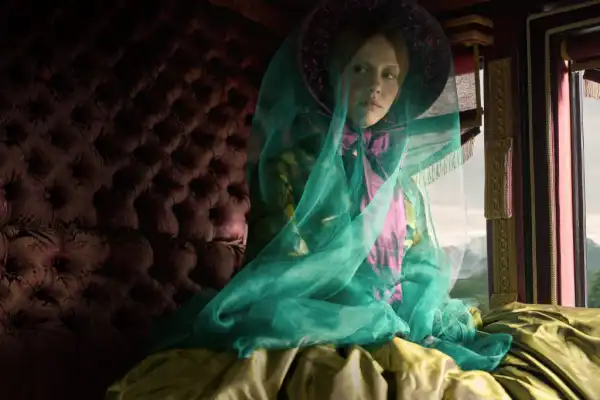
Within the film, the character is known as Lady Elizabeth Harlander, who is engaged to Victor’s younger sibling, William. She and Victor forge a playful connection rooted in their mutual passion for science, but she eventually declines Victor’s romantic intentions and feels compassion for the Creature.
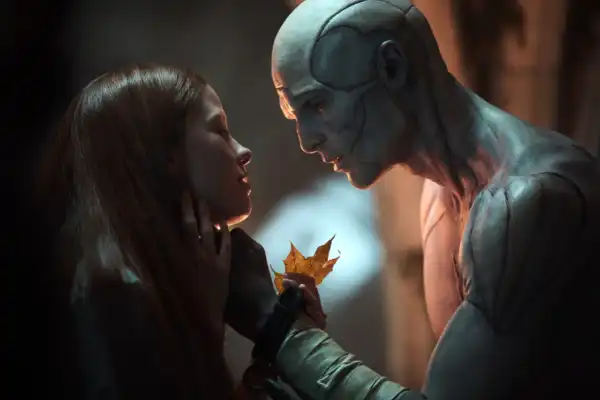
The depiction of Elizabeth’s wedding night contrasts sharply between the book and the movie. The film accentuates Victor’s own monstrous and rash ego when he discovers Elizabeth and the Creature in conversation on her wedding night. Victor implores her to distance herself from the Creature as he prepares to shoot him, but Elizabeth intercepts the bullet, taking it in the chest. She perishes at Victor’s hand as the Creature carries her to a cavernous burial site.
In the book, the Creature murders Elizabeth as retribution against Victor, strangling her on the couple’s wedding night.
The Creature’s Companion in the Book vs. the Movie
Within Shelley’s book, the Creature implores Victor to craft a female counterpart for him, a request to which the scientist consents. However, Victor begins to worry about the possibility of his female creature reproducing, leading him to destroy her.
In the movie, Victor promptly dismisses his creation’s plea and voices his contempt for a female creature’s capacity to procreate. No efforts to produce a female companion ever materialize in the movie.
The Creature’s Potential to Die: Books vs. the Movie
As the novel concludes, the Creature encounters a group of soldiers exploring the icy Arctic (mirroring the movie), and he informs their captain of his intention to immolate himself. It remains ambiguous whether he follows through with his demise, but he is not dead at the story’s conclusion.
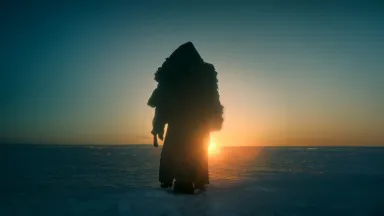
Within the movie, the Creature possesses the characteristic of being unable to die. He cannot be mortally burned, stabbed, or shot. His destiny remains undetermined as he ventures into the Arctic alone after assisting the crew of soldiers in their voyage back home.