

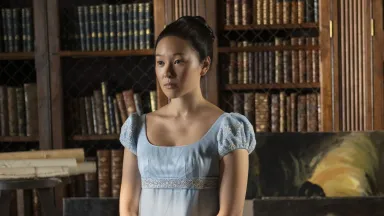
Image Credit: LIAM DANIEL/NETFLIX
The initial episodes of Bridgerton’s fourth season premiered in late January 2026, and as with similar historical dramas (whether fact-based or fictionalized), viewers encountered unique terminology. Early in the season, Sophie Baek (Yerin Ha) is identified as a “ward” of Lord Penwood (Arthur Lee). But what exactly does this signify?
Yerin holds the distinction of being the first Korean actress to have a principal role in Bridgerton, a topic she addressed in a conversation with Time earlier in the year.
“When my representative informed me about Bridgerton, I assumed it was for a secondary part,” Yerin recounted. “Then, it dawned on me, ‘Oh, this is for the main character. They intend to cast a woman of East Asian descent for the central role.’ … I had never envisioned myself as the female lead in a romantic production.”
Concerning her character, Sophie, Yerin mentioned, “The beauty of [our depiction of] Benedict and Sophie’s story lies in the fact that it doesn’t heavily emphasize, ‘Oh, you’re Korean.’ He simply perceives Sophie as Sophie.”
While awaiting the release of part 2 in February, explore the meaning of the antiquated term “ward” and its relevance to the fourth season of Bridgerton.
During Which Era Is Bridgerton Situated?
Bridgerton is primarily situated within the British Regency period, specifically the early part of the 19th century (the early 1800s).
Defining ‘Ward’: What Does It Mean?
Within the context of 19th-century language, a “ward” typically denotes a minor who is orphaned or a disabled adult who is under the care of a guardian, as indicated by Webster’s and the Mirror.

Credit: Liam Daniel/Netflix © 2025
Why Is Sophie Baek Referred to as a ‘Ward’ in Bridgerton?
Episode 2 of season 4 includes a flashback scene between Lady Araminta Gun (Katie Leung) and Sophie during her childhood. Penwood is present to present his new spouse to his household staff and notably disregards Sophie, yet Araminta takes notice of the child’s existence. Given that Sophie is positioned with the household employees, Araminta queries Penwood, who then verifies that she is his ward.
Penwood subsequently remarks to Araminta, “I trust you will treat her as your own offspring.” Judging by her expression, Araminta is astounded by Sophie’s presence, implying that Penwood conceived a child outside the bonds of matrimony. Consequently, he alludes to her as his ward due to his societal standing.