

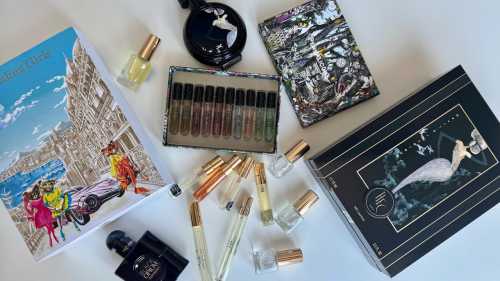
You seem to have been wearing the perfume conscientiously, you liked everything. But suddenly the luxurious composition starts to smell like a burnt boot, marinade or an unwashed body. In the beauty community, such fragrances are called “werewolf perfumes”. Consultants in stores usually roll their eyes and sigh sympathetically: “Well, it's just the chemistry of your skin, not your story…”.
But is our skin really to blame? Or maybe it's the games of our own brain and the banal economy of perfume brands? Why do fragrances play cruel jokes on us?
The illusion of purity and the spirit of the sewing shop
Take, for example, the popular Zarkoperfume The Muse. Have you ever been to a large industrial laundry? Or the ironing department of a sewing shop? Well, this is not a fantasy about freshness. It is literally the smell of a hot iron and kilograms of washing powder. On the street in the cold — yes, it is crisp cleanliness. But in a warm room it is impossible to wear it.
Or another story — Sierra from Attar Collection. At the start, these are modest blue flowers, some kind of wild forget-me-nots in a fashionable cashmere scarf. No heavy East, everything is very correct. But two hours pass, and the forget-me-nots mutate into a clumsy, cheap fabric conditioner.
Why does this happen? Light floral notes quickly evaporate from warm skin, and the “base” remains. And the base of modern perfumes contains synthetic musks. The trick is that chemical concerns sell the same musks to manufacturers of household chemicals. Therefore, your brain identifies this smell absolutely correctly: it really is the smell of fabric softener, just poured into a beautiful bottle.
But the most interesting thing is when, in the same Sierra or Soleil by Lalique, the girls suddenly smell… the scent of a herring tail. Distant, as if the wind had brought it from the neighboring balcony.
Perfume molecules can't turn into fish. This “herring” is neurobiology. It's either your individual skin microbiome's specific reaction to musk, or the distorted perception of smells that has become a mass phenomenon after the COVID-19 pandemic.
Pickles, morning beer and hospital bandages
If you think these are isolated “glitches” of smell, then welcome to the club.
Now, you can see women on the streets wearing pickles and dill. The legendary Le Labo Santal 33 or the luxurious Versace Crystal Noir sin ungodly with this. And again, this is not a curse. It's just that synthetic substitutes for sandalwood (for example, the Javanol molecule) have green and lactone aspects. Mix this green with the warmth of your body – and the brain joyfully gives out the association: “Oh, grandma's pickle!”. By the way, if you read about cucumbers in Le Labo on forums, you will 100% feel them there. This is the psychological effect of suggestion: the brain is simply looking for a familiar pattern.
Or let's take the elegant chypre Hermès Barénia. It would seem to be a status fragrance, absolute luxury. But you should enter the room with it and wait an hour… And suddenly it starts to openly smell of beer! And so thickly and naturally, as if you were sitting in the very center of the brewery. Colleagues are already starting to look suspiciously at you and delicately ask if you've had a glass or two of unfiltered morning brew. What kind of Parisian chic is that when you smell like a craft pub?
And the famous one — Baccarat Rouge 540 with its eternal iodine, pus and hospital bandages. Do you know why some smell strawberries and cockerels on a stick, while others smell an operating room? It's all about partial insensitivity to certain scents. The molecule ethyl maltol is responsible for the sweet cotton wool and strawberries, while the sterile bandages are made up of a synthetic substitute for oak moss, evernil, combined with a note of saffron. Some people's receptors quickly block the “heavy” molecules of evernil, and they only feel the sweetness of ethyl maltol. Others, on the contrary, do not perceive the sweetness and get a “hit” from the bandages. That is, the brain simply “does not see” half of the perfume formula.
The inconvenient truth about niche and climate
How many awards has Estee Lauder Bronze Goddess won! When you buy it in the summer, you expect the scent of sun-warmed skin. But you get the suffocating smell of old bronzer. Paradoxically, this purely summer perfume opens up fantastically and sonorously precisely in sub-zero temperatures. The famous Bal D'Afrique by Byredo, on the contrary, shows all its beauty only in the summer heat, and becomes flat in winter. This is physics again: in the heat, heavy notes evaporate simultaneously with light ones, creating a suffocating cloud. In the cold, they “freeze.”
But let's be honest. Sometimes the problem isn't your skin, the weather, or your hormones (although cortisol from chronic stress does change how we smell).
Sometimes the problem is that the industry is fooling us a little.
When the hyped Musk Therapy from Initio gives someone the smell of boiled citric acid, and hits from Ex Nihilo or Kajal Lamar drill the brain with an aggressive chemical note (up to the smell of corpses) – it's not you who is wrong. It's the manufacturers who use cheap, but nuclear in their resistance, ambergris materials. The cost of the liquid in a bottle for 300 euros is often a penny. So when a perfume smells of dichlorvos, you don't need to justify it by saying it's “not the right season”. It's just a poorly put together formula.
How not to buy a perfume nightmare?
Forget about blotters. The paper in the store will stand up to anything. Moreover, a tester under the hot lights of a boutique and a new bottle in mica can smell different. Always apply the perfume to yourself.
Wait for the base. Don't buy perfume in the first 15 minutes. Go for a walk. Wait for the flowers and citrus to take off. It is the base that will stay with you all day. If after two hours a “Christmas tree” has crept into the car or air conditioner for clothes – it will not work.
Don't suffer for the sake of the trail. Some scents (like Cocaine by Franck Boclet) can leave a divine trail in the air, but up close they can suffocate the wearer. Perfume should be about you first and foremost, not an act of beauty masochism for the sake of compliments from passersby.
Listen to your body. If suddenly all your favorite perfumes start to smell unpleasant (ammonia, fish, garbage), put the bottles aside and check your health. Often this is a signal from the endocrine system or the effects of viruses, and not a conspiracy of perfumers.
Every scent has its limitations and its time. We have too many real reasons for stress these days to tolerate the discomfort of our own perfume. If it smells like unfiltered beer, get it off your shelf.
Share
Subscribe to UkrMedia on Telegram.
⚡ Readers' Pulse
Has the insidious werewolf perfume settled in your collection?
0 people have already voted. Join the discussion.
🥒 Yes, I have werewolves! ✨ No, everything is always buzzing 💭 I have my own story
☝️ First choose your position
✏️ Write a comment
📊 Mind map
🥒 Yes, I have werewolves! 0% ✨ No, everything is always buzzing 0% 💭 I have my own story 0% 💡
The discussion is just beginning. Be the first to comment!
Comments
New ones first ↕
There are no comments yet. Be the first!