

The risk of contracting hepatitis from scissors is negligible if there is no visible blood, but it increases when working with a razor. Such cases are real. Although you can't completely insure yourself from all troubles, remembering what to pay attention to in the salon will definitely not hurt you.
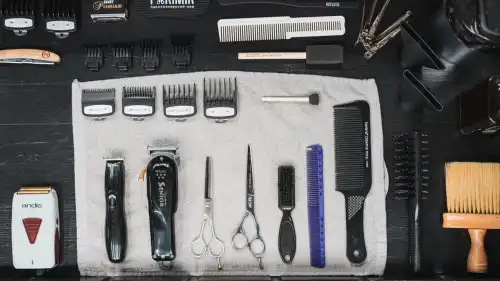
First of all, if possible, pay attention to whether the hairdresser changes scissors and combs after the client who came before you. Every self-respecting master should have two sets of tools, which include combs, brushers, scissors, and clips.
If you are doing a very short haircut using a clipper, it may have replaceable blades, but this is not the only option. Often the blades are not removed, but treated with special sprays that clean and disinfect, or soak only the working part. All of these tools are sterilized or disinfected.
Metal tools, if they have had contact with blood (for example, accidentally cut the skin during a haircut), are sterilized. All combs and clips are disinfected: first washed with water and detergent to remove dust and epithelium residues from the client, and then soaked in a disinfectant solution. The nozzle of the hair dryer, since it does not touch the skin directly, is enough to wipe twice with a napkin with disinfectant. It is recommended to store combs in a UV sterilizer, which maintains their sterility after processing.
Try to keep track of all of the above if you arrive at the salon early and are waiting for the technician to leave. Instead of staring at your phone and reading news, comments, watching cats and memes, they won't go anywhere.
If you don't see where the master gets the tool from, don't hesitate to ask how he processes the combs.
A small remark on the topic of disinfection and sterilization, some people do not see the difference between these two procedures. Disinfection reduces the number of microorganisms on the surface of something. Special means are used for disinfection. Sterilization kills everything: microbes, viruses and fungi. There are physical (steam, heating) and chemical (liquid and gaseous substances).
Clients sometimes don't even know if they have any scalp diseases. We have a rich microbiota there, there are harmful and beneficial microorganisms. Even controversial ones, such as malassezia: there is still no consensus on whether it is worth getting rid of them completely or not, but they are involved in dandruff and skin diseases. Just 10 years ago, they were considered non-pathogenic, but now the opinion of dermatologists has changed.
In any case, the instrument must be disinfected and sterilized. Many of us may not have diseases, but we are carriers of the same yeast-like fungi.
Pay attention to the towels they use to dry your hair after washing (after dyeing). Also, look where they put the towel after you. One towel per client, you can't use one towel to dry several clients.
Usually, salons have baskets with used towels, which are washed at a temperature of 90 degrees, and after drying, heat treated (ironed).
It is a good sign when the salon uses disposable materials: towels, napkins, aprons, robes, collars. When using a reusable robe, the master must use disposable collars so that the robe does not touch the skin directly. Reusable aprons should also be washed and treated with a disinfectant solution.
Sweeping brushes, which the master uses to sweep cut hair from the neck and face, are not prohibited. But they must be treated with a disinfectant. It is better, of course, if the master does not use it at all, but removes the hair with a disposable napkin or cotton pad. If you do not want the master to remove hair from your face, you can always say so and remove it yourself.
As for the hairdressing salon, there are no such strict rules for handling tools as, for example, in manicure. After all, the risk of injuring the client is not so great. The hairdressing salon may not have a dry heat cabinet, if it is not a barbershop, because men's haircuts are very short and the risk of injuring the client is much higher. There, the master is generally better off having more than one hair clipper, with replaceable blades.
You can trust your master endlessly, but no one wants to treat seborrheic dermatitis or, for example, pediculosis (lice).
Share
⚡ Readers' Pulse
Is your hairdresser a professional or a peddler of a dangerous infection for your money?
9 people have already voted. Join the discussion.
🛡️ I demand complete sterility! ✂️ Enough of the pointless paranoia! 🤔 My experience is mixed
📊 Mind map
🛡️ I demand complete sterility! 33% ✂️ Enough of the pointless paranoia! 11% 🤔 My experience is mixed 55%
Comments
Optimistic Capybara 🛡️ I demand complete sterility! 01/30/2026 12:37 I demand complete sterilization of tools and all the tools they use during a haircut or manicure according to all the rules, but….. If I pay attention, for example, to my hairdresser, then I probably won't be able to go to her anymore, she has a temper, she won't tolerate any remarks, although she probably doesn't sterilize tools and other tools for work. In a word, she cuts everyone with the same tools. It is necessary that there be checks by the relevant services, so that they are afraid and do everything correctly, at least by an auditor. 💯 2 + Reply Polite Kivaka 🤔 My experience is ambiguous 01/30/2026 09:52 In my opinion, they rarely change scissors and combs. I don't see how many children I cut, so that they can just wash them when they change. 👍 1 + Reply