

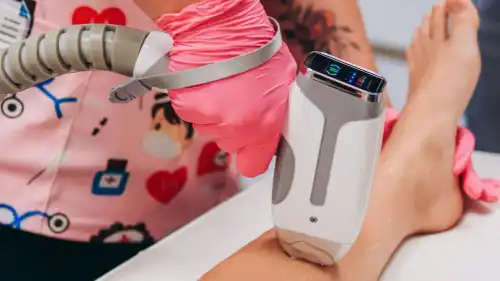
Excess body hair is a constant headache: you have to shave often, but no one has ever eliminated the irritation, and waxing is quite painful. And here it seems that laser is a salvation and the perfect solution to the problem. But can it really remove blond hair forever?
A golden rule that is often forgotten in advertising: any laser loves contrast. The lighter the skin and the darker the hair, the stronger the “wow” effect. Does the laser remove blond hair? If so, what kind? What is so special about blond hair?
How does laser hair removal work?
The laser beam affects the melanin in the hair follicle and the hemoglobin in the blood vessel that feeds the hair. This leads to heating of the follicle and its destruction.
But with blond hair, the real lottery begins: everything is more complicated here, and the master will have to sweat over the settings, and you will have to be patient for a long course.
Melanin deficiency in blonde hair leads to several problems:
- They do not absorb the light generated by the device well, which reduces the effectiveness of the procedure;
- More sessions are needed to completely remove unwanted vegetation;
- Higher energy settings are required, and therefore the risks of thermal skin damage increase.
Can GREY hair be removed?
Gray hair has no melanin at all. That’s why it looks translucent, thin, and almost weightless. Due to the lack of pigment (a target for light), the laser simply “doesn’t see” such hair. Removing gray hair with a laser is a waste of money.
Which laser is best for removing blonde hair?
Today, cosmetologists use:
- alexandrite
- diode
- neodymium
- ELOS hair removal, which combines laser radiation with electrical stimulation.
Alexandrite laser
The alexandrite crystal amplifies the light, creating a beam that pinpoints the pigment. The beam penetrates the skin, where it is absorbed by melanin (the pigment in the hair).
The laser energy heats the follicles, which leads to their destruction. The surrounding tissues are not damaged because they contain less melanin.
Diode laser
The diode laser generates waves with a length of 800-900 nm, which allows it to penetrate deeply into the skin. This device does not remove gray hair due to the lack of pigment. Removing very light and vellus hair with a diode laser is possible, but it is a difficult task: the result requires high power and a larger number of procedures compared to working with dark hair.
Neodymium laser
Epilation is not one of the basic functions of this device. The wavelength of 1064 nm allows energy to penetrate deep under the skin. The target of the neodymium laser is hemoglobin (blood pigment). The device has a destructive effect on the vessels that feed the follicle. And the interaction with the melanin of the follicle is minimal.
This device can, of course, be used to remove blonde hair, but for a good long-term result, you will need many sessions. The procedure itself, to put it mildly, is not a pleasant one – be prepared for it to be really painful.
ELOS technologies
ELOS hair removal combines light and radio frequency radiation. But, despite the great promises of marketers, the technology has quite a few drawbacks.
1. It will take 15-20 sessions to get rid of blonde hair;
2. When working with blond hair, a sufficiently high power of the device is required – painful sensations cannot be avoided;
3. In the case of ELOS, there is a risk of overheating the skin, however, the combination with RF energy (current) was created specifically to affect the follicle when optical energy (light) is not enough to heat blond hair.
The choice remains between diode and alexandrite lasers.
Diode or Alexandrite laser: which is better for blonde hair?
Efficiency:
Alexandrite lasers (wavelength 755 nm) have a higher melanin absorption coefficient than diode lasers. Therefore, they are better at removing fine and light hair, since the short wave “sees” a small amount of pigment better. Diode lasers (808 nm) penetrate deeper, but are less absorbed by melanin, which makes them safer for dark skin, but less effective for very light hair.
Security:
Diode lasers are indeed safer for working with dark and tanned skin. However, when removing light hair, the diode device must be set to high power settings to heat the follicle, which increases pain and the risk of burns. The alexandrite laser is able to destroy light hair at lower energy.
Duration of effect:
The duration of the effect depends on the quality of the follicle destruction. Since the alexandrite laser has a more aggressive effect on the pigment of light hair, a course of procedures with it often leads to the desired result faster, and the effect lasts longer than when trying to remove the same hair with a diode laser.
Fewer side effects:
When working with fair skin and fair hair (for which the alexandrite laser is ideal), the risk of side effects is minimal with proper cooling. Diode lasers cause fewer reactions, especially on dark skin, where alexandrite cannot be used.
Versatility:
Diode lasers are versatile and can be used on different skin phototypes (from light to dark). However, if it is specifically about light hair on light skin, a specialist will most likely recommend an alexandrite laser.
Can blonde hair be removed permanently?
I'll be honest with you: NO! Miracles don't happen.
Laser hair removal does not remove hair once and for all, but it definitely does for a long time!
Accept the fact that laser is like a manicure: after the basic course, you will still have to visit a beautician every 3-6 months to maintain the result.
Share
⚡ Readers' Pulse
Is laser for blonde hair a lifesaver or a waste?
0 people have already voted. Join the discussion.
😻 Yes, the effect is great! ✨ 😤 Money down the drain 💸 🤔 Everything is complicated… 🤔
📊 Mind map
😻 Yes, the effect is great! ✨ 0% 😤 Money down the drain 💸 0% 🤔 Everything is complicated… 🤔 0% 💡
The discussion is just beginning. Be the first to comment!
Comments
There are no comments yet. Be the first!