

These scents are not found on basenotes, fragrantica or sephora: they are sold in church shops and in small “lamp” Instagram shops . Why has the world gone crazy with the “canonical” scents of incense and myrrh, and is it worth evicting niche perfumery from the shelves in favor of fragrances that are accessible in every sense?
Advertising.
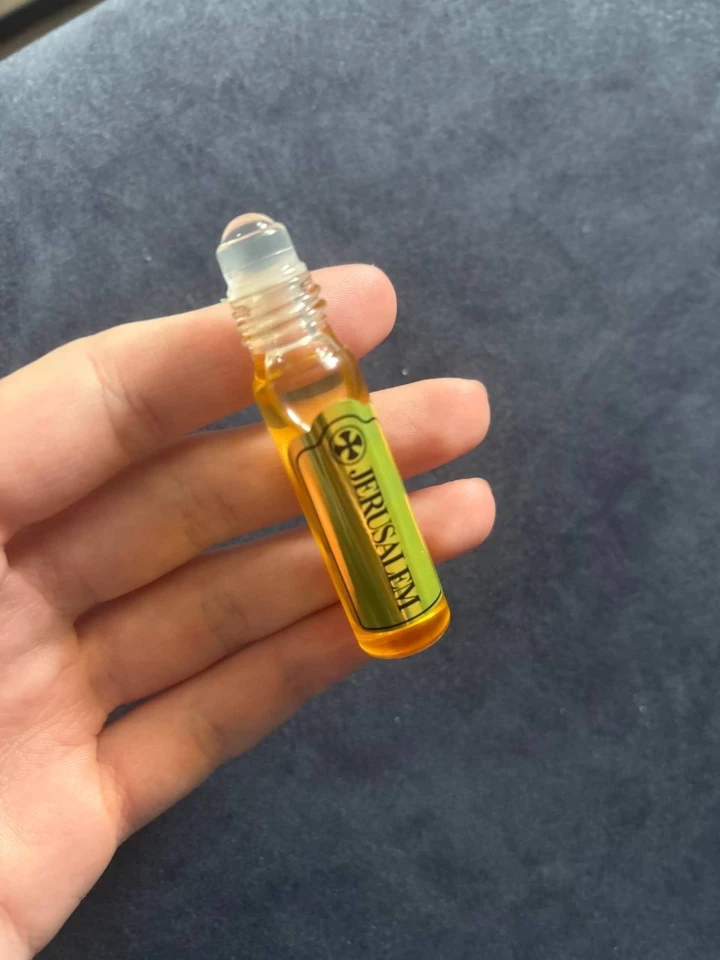
“A small tube with the inscription Jerusalem, no description of the notes. The smell is sweet at first, then church incense. It smells like a priest who ate a chocolate bar,” says Vogue UA photo editor Eliza Prozheyko about the fragrance she just bought at St. Volodymyr's Cathedral.
Iryna Katyuk, a member of the Ethnodom NGO, who has spent at least 15 years working for the L'Oreal Group in Paris and Kyiv, says she also does perfume and church shopping. Instead of perfume, she buys candles — “They smell of honey and incense. Calm and warm. It's like walking into church with your grandmother by the hand.”
Threads, TikTok, and Instagram have conquered a new trend: neophytes and experienced users are making secular raids on church pews — and creating an unprecedented demand for perfumes, candles, incense, and myrrh.
Why people are interested in “church” fragrances
“Today's interest in “church” smells has not so much an aesthetic as a psychological basis,” says perfumer, olfactologist, and perfume expert Bohdan Zubchenko. “People live in a state of anxiety and uncertainty – and naturally seek support. The easiest way is to return to familiar experience, often from childhood.” So those who at least sometimes visited church in childhood clearly remember the aromas that prevailed there: incense, myrrh, resins. It is worth inhaling them again – and you can teleport to serenity.
Perfume blogger Daniil Prybylsky, known on Instagram as @king.of.fragrance.s, believes that the trend came from the Western segment of TikTok, where bloggers began to actively romanticize Gothic and temple aesthetics. “The 'real niche' has returned to fashion, only now in the pyramids of fragrances you can see strange notes: holy water, candle wax, cold cathedral floor or even damp earth (examples of brands are Romanian Toskovat or Italian Filippo Sorcinelli).”
Daniel says that in the study of “church-parish” fragrances, Ukrainians went much further: “Instead of simply buying expensive bottles with the “smell of church” from well-known brands, we started looking for authentic fragrances directly in church pews. This turned out to be a much more interesting experience: finding real olfactory treasures where no one had looked for them before. It was this request for “petty” that fueled interest in church pews as a source of an inexpensive but very characteristic product. And this is real perfume punk rock.”
What fragrances can be found in the church shop?
Myrrh, frankincense, myrrh — all of these can be found in a church shop (even in the excitement of unbridled shopping, one should not support the Moscow Patriarchate). But what are these substances and where do they come from?
In the book “The Essence Hunter: A Journey to the Sources of the World's Fragrances,” French expert on natural perfume ingredients Dominique Roque writes: “Myrrh is the resin of trees of the Commiphora genus, and frankincense is the resin of trees of the Boswellia genus. These trees grow in a region that extends from eastern Oman and northern Yemen to Eritrea and Ethiopia, covering the entire northern coast of the Horn of Africa and down to Kenya. Myrrh and frankincense are gum-resins, natural juices that flow through cuts in the tree. They are partly soluble in water and partly in alcohol.
Bohdan Zubchenko notes that frankincense has a dry, smoky, resinous undertone with a woody structure, while myrrh is deeper, with a moist, almost earthy undertone, sometimes associated with mushrooms and dampness.
It is important to distinguish between myrrh, also known as myrrh, and myrrh. Myrrh is the aromatic resin of trees of the genus Commiphora: a natural ingredient with a bitter, astringent, balsamic odor. According to biblical tradition, it was myrrh that the Magi brought as one of the gifts to Jesus.
Myrrh is a complex multi-component mixture prepared on the basis of olive oil (butter) with the addition of wine, aromatic herbs, and resins – including myrrh itself.
It is this “church cocktail” that hunters of authentic scents are hunting for today. The consecrated mixture, which in the church tradition is prepared during a special rite of myrrh-making, creates the same warm “unearthly” trail. Prybylsky notes that the myrrh smells coniferous, smoky, with shades of leather and bitter steppe herbs and powdery flowers. “It evokes the vibe of the ancient Florentine brand Santa Maria Novella, which, by the way, is also sold in the pharmacy at the cathedral.”
Bohdan Zubchenko recommends paying attention to opoponax, a resin that has a warm, balsamic, slightly sweet profile, closer to benzoin or styrax. It is part of the base accord of the legendary perfumes Shalimar and Guerlain.
Pros, cons, pitfalls
Prices for niche perfumes are constantly rising: a 100 ml bottle of “niche” perfume today will cost from UAH 10,000. Against this background, UAH 40 for a 10 ml bottle with a roller in a church shop is tempting. In addition, the experience of shopping in a church shop will easily give you a head start on shopping in fashionable modern spaces. None of them boast vaults stretching into the sky, stained glass windows, frescoes and golden light pouring from the dome of the church. Unless they don't provide blotters.
Isn't this a reason to switch to “God-pleasing” fragrances? Unfortunately, the answer is: “No.”
Will fragrances from church shops compete with perfumes?
Bohdan Zubchenko explains that even the perfume materials sold in churches — the same incense that smolders in a priest's censer — are unsuitable for perfumes. “Incense for incense is not suitable for a perfume composition — it cannot be infused and does not yield perfume material: even if you make a tincture of it in alcohol, nothing will come of it.”
Bohdan explains that incense differs even on the outside. And while perfume incense is a liquid processed according to certain standards, church incense is lumps of material.
Daniil Prybylsky adds that real frankincense resin (for example, from Somalia) is not cheap, so temples usually use “Athos incense.” “It is a mixture of coniferous resins and damar tree resin, which is ground into powder, essential oils are added and kneaded into a “dough”, which is then cut into small fractions. Real frankincense is hard and does not have the same shapes. But “Athos incense” smells pleasant: from sweet, almost vanilla overtones to green and fresh counterpoints.”
Are no name essential oils from the church safe ?
“Formally, you can apply anything to your skin,” says Bohdan Zubchenko. “Ultimately, it's your business.” However, the perfumer urges you to remember a few things:
- Products from church pews are not designed for perfumery use
“Often it is a base oil (olive or jojoba) with a minimal amount of aromatic raw materials,” says Zubchenko. “That is, the concentration of active substances in it is very low, and one should not expect either disclosure, stability, or a plume (diffusion).”
- “Church” oils, where the composition is often not even indicated, can cause allergies
“Even if the substance itself does not cause a reaction, it can be included in other biochemical processes, trigger sensitization , provoke an allergy that did not exist before – for example, due to cross-reactions with pollen or other allergens. Therefore, natural does not equal safe,” emphasizes Bogdan.
Since the sense of smell is directly related to memory, in the search for new olfactory impressions it is worth not to delve into embarrassing memories. After all , incense can be associated not only with peace or celebration, but also with the experience of loss – for example, saying goodbye in church. And then the aroma triggers a completely different emotional scenario than the one we expect when researching perfume trends.