

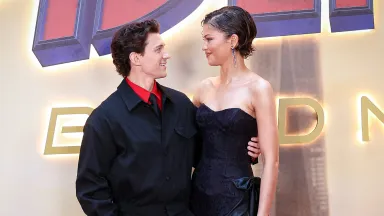
Image Credit: Getty Images
Tom Holland has voiced what many were thinking. He is married to Zendaya. He referred to her as his soulmate. He declared he is experiencing unparalleled happiness.
And the online community reacted emotionally, as expected. For years, these two have been the most discreetly committed couple within the Marvel sphere. No awkward public displays of affection, no puzzling social media silences, just two individuals who appear to share a genuine sense of stability with one another.
So, why did reading his statement evoke a subtle sense of protective instinct, akin to a therapist’s concern?
Because the declaration, “I’ve found my person, and I’m happier than I’ve ever been,” is one of the most profound yet potentially fragile statements a person can make publicly. I frequently encounter this sentiment in my practice. Typically, it precedes the first significant conflict by about a year.
The science behind “my person”
What’s occurring when Tom makes that statement about Zendaya is not merely poetic expression. He is articulating a biological phenomenon.
Attachment theory offers the most robust explanation for the nature of love. In essence, love is the inherent need for emotional connection with another individual. According to this theory, this need is universal and fundamental, existing from infancy to old age, irrespective of the comforts provided by modern conveniences.
At birth, your requirements extended beyond sustenance and shelter. You also needed a reliable presence, someone who would be consistently available and affirm your intrinsic worth. Without this, survival would have been impossible. This innate wiring does not diminish with maturity; it simply adapts its focus.
For Tom, Zendaya now fulfills this role. His entire being is continuously assessing her, seeking answers to two core questions: Are you reliably present for me? And do I hold sufficient value in your eyes?
This is the actual meaning behind “I’ve found my person.” He has designated her as his primary attachment figure. While this is wonderful, it also signifies a subtle increase in the emotional stakes for both of them.
During the initial phase of a relationship, every word and action from a partner is perceived as confirmation of enduring love, reassurance of future cherishing, and validation of a preordained destiny. Both individuals operate in a heightened emotional state, convinced of the permanence of these feelings.
Then, inevitably, a subtle shift occurs.
The overlooked turning point
In my professional experience, this transition often arises from the most commonplace of situations.
Imagine a car journey. You might point out something to your partner, saying, “Look at that unusual bird over there.” If they fail to acknowledge it, or if they shift a blanket towards themselves a bit too abruptly, you might find yourself questioning their reaction. What triggered that?
That’s the pivotal moment. The initial, barely perceptible fraying of the honeymoon phase. Your autonomic nervous system registers it before your conscious mind does, leading your partner to wonder if you are displeased. Conversely, you may be experiencing similar inquiries about their behavior.
Couples continuously navigate these dynamic patterns. Often, awareness only arises when these subtle exchanges escalate into overt conflict. However, these micro-interactions are constantly occurring, much like a child seeking reassurance from a parent across a park: “Are you still there, Mom? Where are you now?”
The greater one partner feels a sense of abandonment, the more they may withdraw from the other. Consequently, the partner who feels rejected may find it more challenging to offer love and support. This can lead to amplified feelings of abandonment and further withdrawal, creating a cyclical pattern. This is where most relationships encounter difficulties, and it has little to do with whether they are truly each other’s person; they are. This very fact is precisely why the pain is so profound.
If you wish to understand your relational dynamics before a major crisis emerges, it is far more beneficial to address it now than at 2 a.m. following an unforeseen argument.
Disconnection: An inherent aspect, not a flaw
There is a crucial insight I wish someone had shared with Tom and Zendaya at their wedding, and which I impart to every couple experiencing the initial euphoria of their relationship.
Interpersonal disconnection between two individuals who care deeply for each other is an intrinsic element of the relationship, not a malfunction. People commonly perceive disconnection as an error that needs to be rectified. This is a misconception. Disconnection is actually evidence of profound love and the mutual fear that arises from the significance of that bond.
The most intense conflicts within a relationship occur precisely because of the depth of love shared between partners. A disagreement is essentially a profound miscommunication of that affection. The reason individuals engage in such painful dynamics stems from shared internal hurt, a feeling of being unloved in that particular moment.
And here is a gentler observation for Tom: If you believe the ultimate objective is to express your authentic self in every aspect of your life without ever causing your partner distress, you are setting yourself up for challenges. It is virtually guaranteed that at some point, your very nature will profoundly affect Zendaya. Similarly, she is bound to have a comparable impact on you. The scientific principles of enmeshment and how couples inadvertently attempt to navigate this by becoming overly intertwined do not shield you from the inherent difficulties. Nothing can. The challenging aspects are an unavoidable consequence of deep love.
The part of you that craves connection the most is not a sign of weakness or neediness. It represents the best of you and deserves to be met with love.
What being his person truly entails for her, and vice versa
Therefore, if disconnection is an anticipated part of Tom and Zendaya’s journey, what is the most effective approach?
Abandon the ideal of a conflict-free relationship. Successful partnerships are not solely characterized by the abundance of positive experiences. They are defined by each partner’s proficiency in providing themselves and each other with opportunities for reconciliation.
During disagreements, strive to view them through the lens of attachment. Can you perceive your own reactive responses as stemming from a need to be significant to your partner, or from a need to be sufficient for them? If so, you will recognize that conflicts arise solely from your mutual affection. No other underlying cause is at play. This shift in perspective, applied consistently across countless small moments, is what truly sustains a marriage.
The act of repair is the ultimate affirmation. Not the absence of rupture, but the subsequent return to connection.
A final thought for the happiest man alive
Tom, should you ever encounter these words, my sincere congratulations. You have indeed found her. And the day she does something minor that leaves you breathless, or you do the same to her, understand that this is not the end of your love. It is the love maturing into reality.
The pinnacle of happiness you are experiencing is not a destination reached at the altar. It is something you will continue to construct, repeatedly, each time one of you extends a hand across the divide of disconnection, affirming, “I am here; return to me.”
Figs O’Sullivan, the founder of Empathi, and his wife, Teale, are marital counselors based in San Francisco. They are renowned relationship experts for celebrities and Silicon Valley figures, the creators of Empathi, and the developers of Figlet, our AI relationship coach, which has been trained on their extensive clinical practice.