

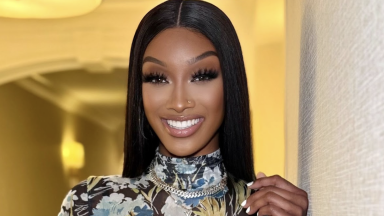
Image Credit: Jazz Anderson
Within a business perpetually in search of its subsequent prominent figure, Jazz Anderson isn’t anticipating discovery; she’s appearing completely realized.
Anderson showcases a calm self-assurance that doesn’t solicit notice but seizes it regardless. It mirrors the type of aura casting directors reference when mentioning the “X factor.” An ethereal trait that defies fabrication, only acceptance. And increasingly, it’s achieving acknowledgment in both the realm of music and motion pictures.
While numerous up-and-coming individuals devote years endeavoring to characterize their identity, Anderson’s dual nature is precisely what distinguishes her. She transitions effortlessly between avenues: a music creator wielding a poignant lyrical standpoint and a performer boasting emotional acumen surpassing her age. That junction where artistry encounters genuineness is where she’s initiating the charting of her singular path.
A Screen-Ready Presence
Anderson’s onscreen captivation stems from her aptitude for holding her ground, a characteristic that’s remarkably manifest throughout the spectrum of projects she’s purposefully assembling.
In Lifetime’s 2023 factual crime storyline, Girl in the Closet, Anderson embodies Angela, the offspring of a severely disrupted domestic situation at the heart of a distressing narrative rooted in real occurrences. Performing alongside Tami Roman and Remy Ma, Anderson maintains her composure within an emotionally charged tale centered on hardship, regulation, and resilience.
Rather than exaggerating the amplified gravity of the subject matter, Anderson gravitates toward composure. It signifies a decision that emerges as inherent rather than calculated, signaling an actress who grasps that onscreen impact doesn’t invariably stem from decibels, but from sheer presence.
That equivalent instinct is observable in her involvement in the suspenseful Dying to Be Famous, where she navigates a more modern, culturally infused perspective on drive and selfhood. Across both initiatives, a recurrent motif is evident: Anderson refrains from pursuing the instantaneous moment, opting to refine it.
Dating back to her early career, highlighted by a role in The Last Stand, initial indications emerged regarding the emotional insight and groundwork she’s presently enhancing into a more regulated and intentional entity.
Directors and fellow workers continually highlight her attentiveness. Anderson transcends mere dialogue recitation, reacting in a manner that enriches the entirety of the sequence. She appreciates cadence, not solely melodically, but also dramatically.
That innate sense transmutes into portrayals that exude authenticity rather than staged presentation. A delicate yet pivotal distinction, positioning Anderson not merely as an emerging individual, but as an actress cultivating a distinctive viewpoint.

Future Prospects
Anderson is actively formulating numerous ventures through her cooperative connection with Roman Ramsey Productions. Notably, Electric, a Southern academy-situated drama scrutinizing dominance, aspiration, and identity within a demanding university environment.
The emphasis rests on parts that permit her to elaborate on psychologically complex personas, emotionally gripping stories, and narratives that spotlight women in frameworks that resonate as simultaneously sophisticated and culturally pertinent.
It’s a thoughtfully considered implementation. One envisioned not for instant overexposure, but for enduring influence.
Key Conclusion
Hollywood doesn’t experience a paucity of fresh countenances. The void it encounters and persistently seeks revolves around performers who evoke inevitability.
Jazz Anderson embodies inevitability.
Not as a result of publicity, but owing to concordance: aptitude, timing, and a firm comprehension of her place and forthcoming trajectory.
And if preliminary industry murmurs hold weight, she won’t linger as merely “one to monitor.” She’ll evolve into one to emulate.