

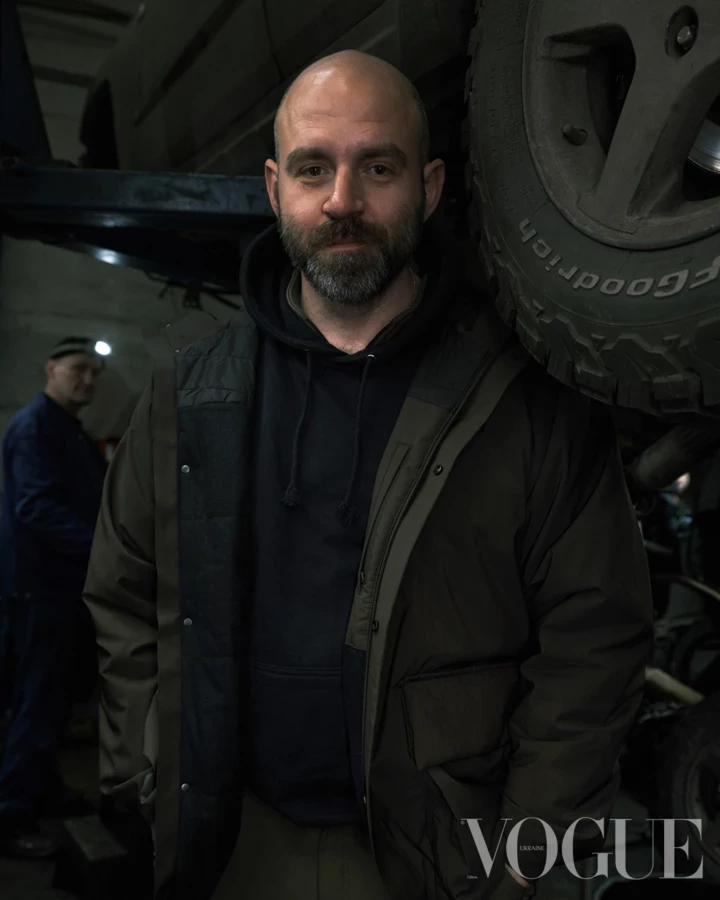
In the “Heroes” project, Vogue Ukraine honors military personnel, medics, artists, energy workers, paratroopers — fallen and alive — victorious Ukrainians who, with their daily work, help the country survive in the darkest times. 42-year-old Pavlo Kazarin, a senior sergeant of the unmanned systems battalion, a well-known journalist, talks about the army, war, and dreams. Journalist and cultural manager Tetyana Teren spoke with him specifically for Vogue Ukraine.
Advertising.
On February 23, 2022, we met with Pavel for dinner in Kyiv. We briefly discussed the news and agreed that the war unleashed by Russia in 2014 would not spread deep into the country. Perhaps it was a defensive reaction, but that evening we were making plans. I told him that I had wanted to move to another area of Kyiv for many years; Kazarin admitted that he had decided to buy a new car six months ago and had already made a deposit for it. He showed me photos of a red car, and I stereotypically remarked that men choose bright-colored cars because of a midlife crisis.
A few hours after the first explosions in Kyiv, we exchanged short messages about what was going on around us. We joked that it seemed like the move, the red car, and the midlife crisis were being postponed.
Before the full-scale invasion, Pavel Kazarin was a well-known journalist: he hosted projects on television and radio — morning broadcasts on the ICTV channel, socio-political talk shows “Countdown” on Suspilny and “Double Standards” on Radio NV. He published analytical texts in leading media outlets every week. For his journalistic work, he received almost all the country's major professional awards, including “High Standards of Journalism” and the Georgy Gongadze Prize. For many, he was the necessary voice of an adult who dissected and explained our turbulent times, ordering — by his own definition — chaos into a state of meaning.
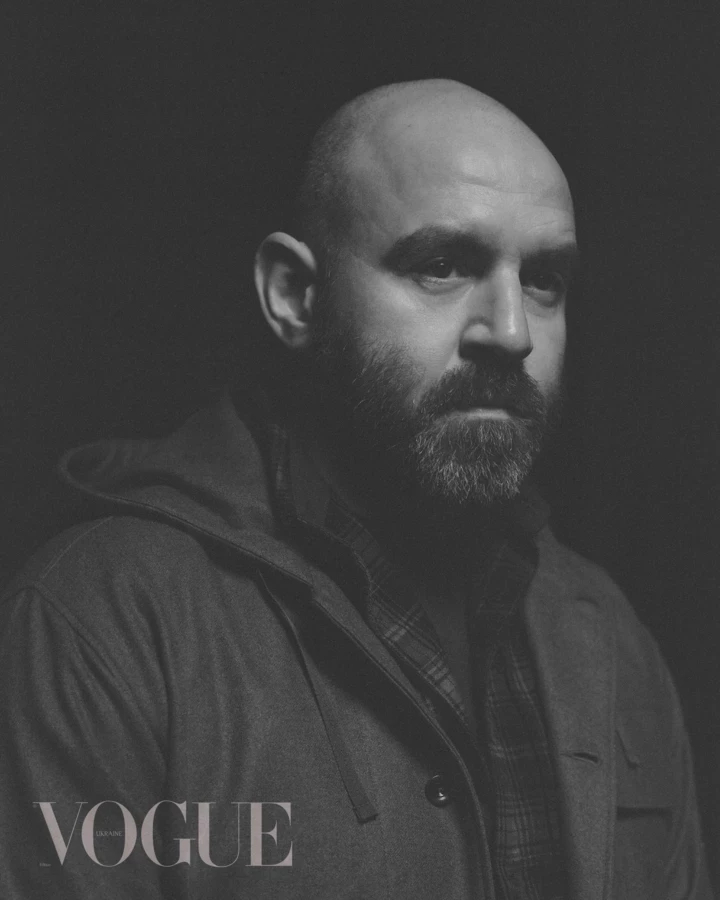
For many, Kazarin was that necessary adult voice that dissected and explained our turbulent times, ordering, by his own definition, chaos into a state of meaning.
In 2021, Pavlov's first book, “The Wild West of Eastern Europe,” was published. The collection of journalistic texts covered seven years since the beginning of the occupation of Crimea. In it, the author explores Ukraine's (and his own) search for its own identity, summarizing the main questions and challenges that our society has faced since 2014. Before us is the programmatic Kazarin: a laconic style, measured words, precise formulations that are broken down into quotes. Ahead was supposed to be a tour of Ukrainian cities, but he managed to present the book only in Mariupol. “I imagined 2022 as the time when I could finally slow down,” recalls Pavlo. “At the beginning of the year, I was working five jobs at the same time. Since moving to Kyiv in 2014, I have been living in a deferred life mode. A significant part of my intentions were subordinated to the program of the millennial generation at least: save up for an apartment, make repairs, buy a car, and have an “airbag”. At the end of 2021, I finally paid off my debts. So I could breathe a sigh of relief, not agree to all projects, and start traveling more.”
On February 25, 2022, Kazarin went to the military registration and enlistment office. “If you publicly proclaim certain values for a long time, you must be ready to confirm them with actions,” he reasons. “If you don't do this at moment X, everything you said so far turns out to be empty talk.” For the first year and a half in the Armed Forces of Ukraine, Pavlo was part of the army media group created by the command of the Territorial Defense Forces, covering battles on various fronts. Later, he was transferred to the strike UAV company of the 104th Territorial Defense Brigade and soon became the unit's chief sergeant. Together with his comrades, he participated in battles in Zaporizhia, Kharkiv, and Sumy regions; now he serves in the Donetsk region.
I ask how the army changed him. “I don't think I've become a different person. If you expect me to say that I was naive and inexperienced in something, but now, on the contrary, I've gained new abilities and knowledge, then no, I won't. The army taught me a lot, explained a lot, this experience is very important, but at the same time I have a strong internal request not to let the army rules inside me. To work not through emotional reincarnation, but in the strategy of “I am in the proposed circumstances,” to use the terminology of acting schools. I don't want these rules to absorb me.”
But I see: he has become more intolerant of many things, can react sharply to an inappropriate joke, often contrasts the army and rear reality. And every time we communicate, I notice more and more fatigue in him. When I ask what helps him hold on, the answer is close to each of us today: “Our war is so black and white in the ethical coordinate system – there is always a feeling that you are on the bright side of history. That is what keeps you going.”
“I have an internal request not to let army rules inside me. To work not through emotional reincarnation, but in the strategy of “I am in the proposed circumstances”
A person in the army lacks two things the most: security and freedom: “There are no concepts of “overslept,” “didn't think,” or “forgot.” No one will take into account extraordinary circumstances if you were unable to complete the task. This approach makes you a professional troublemaker who constantly has to calculate negative scenarios and prepare for them.” Before his service, Pavlo was a person for whom the value of things was determined by their functionality: from time to time he would organize an audit at home to get rid of unnecessary things, and in general he belongs to those who buy the same model of jeans for years if they have stood the test of time. But perhaps some artifacts have appeared in his life that he does not part with when moving to new places of deployment? “In the summer of 2022, I ordered an army medallion — the one sometimes called a “suicide medallion,” replies Kazarin. “Since then, I have worn it instead of a cross. It is my symbolic marker of involvement in the Armed Forces.”
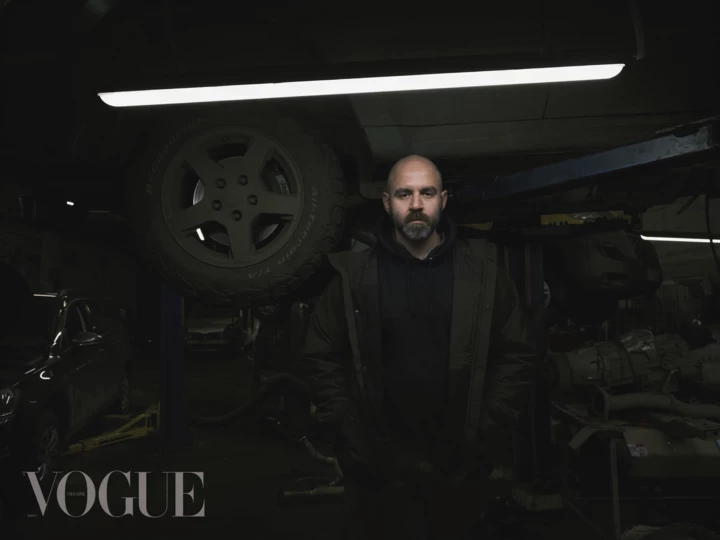
Pavlo calls himself a thick-skinned man and answers questions about his personal life reluctantly. “I know people in the army for whom love and family are a source of strength. But I also know those whose relationships fell apart due to distance. All my relationships were preceded by a long stage of rapprochement. Here the army plays against you: rapprochement at a distance is a very difficult and not always realistic strategy.”
Due to the difference in experiences, many friends have drifted apart, and the circle of friends is becoming narrower. “I really value the periods of freedom called “vacation,” so I prescribe in advance who I want to see and where I want to go. A soldier lives in a space of constant restrictions, and when he gains even a short period of freedom, it becomes clear to him who is still important and who he is no longer willing to waste his time on.”
In the army, Pavlo reads a lot – mostly Ukrainian literature. In the last year, he has been turning to the works of military writers to find out how they make sense of their experience: “People in uniform are the closest to me on the planet today – the commonality of what they have experienced creates a sense of brotherhood. I am interested in reading authors who become the collective voice of the community.” He recommends the collection of short texts “Hemingway Knows Nothing” by Artur Dron, the collection of essays “Everything in Three Letters” by Dmytro Krapyvenko, the prose “Bukuria” by Bohdan Zhuravly, “Who Were We” by Valery Puzik. And also the novel “You Can't Retreat” by his close friend Pavlo “Pate” Belyansky, in which Kazarin appears as a secondary character: according to the plot, he and Pate, already as soldiers, accidentally meet at a volunteer center in Kharkiv. It seems that the author needed this scene to say certain programmatic things about choice and responsibility during war. The novel's hero, Pashka, “an intellectual with the appearance of a criminal,” tells his friends: “If they ask me tomorrow what I did during the war, I won't be ashamed to answer.”
Along with modern texts, Kazarin fills in the gaps in the classics: “I grew up in Crimea, our idea of Ukrainian literature was very primitive. I wanted to find those authors who would speak to me not in the language of an ethnographic journey, but in the language of a shared cultural experience.” Near the front line, he discovered Domontovich, Bahryany, and Pidmohylny.
I ask who Pavlo thinks about before going to bed. “Usually no one, otherwise there's a risk of not falling asleep,” he retorts to my question. “Sometimes I start dreaming about some kind of black swan — an event that will deprive the enemy of the opportunity to wage a war of such scale and intensity. It's a placebo, but sometimes it allows you to fall asleep a little faster.”
“There is a huge demand for finding internal enemies and quarreling with each other. Therefore, I do not make my texts a space for hype, witch hunting and building up entropy. Today, you can easily collect subscribers by trading emotions. I do not want that.”
It is difficult to talk about the future when it is unknown how long the service will last, when the war will end, and who we will be after it. After demobilization, Pavlo would like to return to journalism, but he is convinced that some skills will have to be mastered anew: “My time in the army is years of unwritten texts. Before the service, I wrote two materials a week, today – one a month.” Of course, this was influenced by new living conditions and responsibilities. Self-censorship is added to the lack of time and privacy: “We are a very frustrated, war-torn society. There is a huge demand for finding internal enemies and quarreling with each other. Therefore, I do not make my texts a space for hype, witch hunting, and building up entropy. Today, it is easy to collect subscribers by trading emotions. I do not want this.”
Another “I don't know” in our conversation is the second book. Publishers have repeatedly approached Kazarin with a proposal to publish a collection of new texts. After all, it was for his wartime journalism, published in “Ukrainian Pravda”, that he received the highest award last year – the Taras Shevchenko National Prize. But the time has not yet come, says Pavlo: “I have been accumulating material for the first book for seven years. I don't want to write the second one in a hurry if it will not be interesting to read in a year. Perhaps it will be an attempt to organize the experience of the war, but so far I don't understand what this book should be.”
At the end of the conversation, I ask him not to look into the ghostly future after the war, but to imagine the day of demobilization. What will Pavel Kazarin do first? He will delete Signal on his smartphone and try to wean himself from checking instant messengers twice a minute – in the army, the price of unread messages is sometimes too high. It will still take time to accustom himself to freedom, to the feeling that he belongs to himself again, and not to a large system. “And actually,” he adds, “I haven't been to sea for four years.”
Photo: Iryna Lupu
Style: Sonya Soltes
Producer: Mariia Nikolaienko
Lighting: Michael Aziabin
Stylist Assistant: Yuliia Ostapchuk
Project curator: Alyona Ponomarenko