

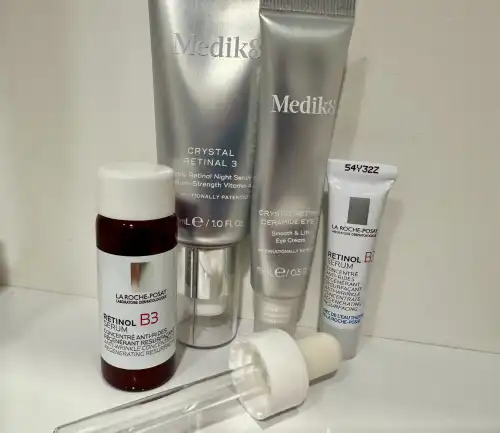
Depending on the product, its concentration in the formula will vary, which directly determines its effect.
Retinol is very effective, which is why cosmetologists love to prescribe it to their patients. Although the component is well studied, it is overgrown with myths. Many of them sound quite convincing and logical.
Retinol is suitable for everyone
Retinol is indeed suitable for most skin types, but not for everyone. The ingredient can be safely chosen by those who suffer from acne, pigmentation, post-acne or have encountered the first wrinkles. However, not everyone can use cosmetics with retinol.
Contraindications include pregnancy and breastfeeding, a tendency to severe allergic reactions, psoriasis, eczema, oncology, hypervitaminosis A, etc. In the case of rosacea, the product is not prohibited, but it should be administered very carefully. Avoid combining retinol with benzoyl peroxide and AHA acids, and separate their use in time (for example, morning and evening) to avoid excessive irritation. People with sensitive skin should be careful and consult a doctor.
Retinol and retinoic acid are the same thing
Both substances solve approximately the same tasks, but they have different capabilities. Retinol is a weak form of vitamin A, so products containing it can be purchased without a prescription. Retinoic acid (also known as tretinoin) is a more serious form. It is used in professional and pharmacy cosmetics for problem skin. Retinoic acid penetrates the deep layers of the skin and provides noticeable results. However, cosmetics with tretinoin are often not available over the counter; they are sold with a dermatologist's prescription.
Retinol thins the skin
In the first weeks of using retinol cosmetics, the skin does indeed become thinner, as dead skin cells are actively exfoliated. But this is the whole point of retinol: the skin becomes soft, smooth and radiant. After that, the epidermis returns to its normal state.
Deep within the skin, the production of fibroblasts, which are responsible for youthful skin, is accelerated. Due to this, retinol has a cumulative effect, you can notice a gradual smoothing of wrinkles, an increase in skin density, firmness and elasticity, and a reduction in other signs of aging.
Not suitable for the skin around the eyes
The skin around the eyes is very thin, delicate and sensitive, so you can’t use regular creams and serums on it. Retinol can also be included in products for the periorbital area, just in smaller quantities. It is important to clearly dose the product and make sure that it does not get into the eyes.
The higher the concentration, the better the effect
If you increase the concentration that is optimal for you, you may cause irritation and redness, but the result will not be better. So listen to your beautician and do not change the concentration at your own discretion.
Retinol should not be used in the summer.
One of the most popular misconceptions. The fears are understandable, but the situation is not as critical as many people think. During the first weeks of using retinol, the skin adapts to it, sensitivity increases, and negative effects such as redness, peeling, and irritation may appear.
Yes, the sun increases the sensitivity of the skin, especially if you have applied retinol. But the problem is completely solved by using sunscreen with SPF 50 during the day. In addition, sun protection is necessary when introducing retinol (and not only) into your daily care, not only in the summer, but all year round. Also, you should not apply retinol in the morning, it is better to leave it for the evening. But if you are going on vacation to a hot country, you should still postpone the care with this component.
Retinol is only suitable for mature skin
The average age for prescribing retinol products is 27-30 years. This is far from mature skin, even though the natural processes of cell renewal slow down at this time. The substance helps correct wrinkles and prevent them. Retinol also helps fight external irritants and oxidative stress, which we have to deal with every day.
There is no need to use retinol at the age of 18, but there are exceptions. It also happens that the component can be prescribed to a child at the age of 12, if there is a severe rash and excessive oiliness of the skin. The drug should be prescribed by a specialist after an examination, self-medication is unacceptable here.
This article is for informational purposes only. Please consult a dermatologist before using retinol.
Share
⚡ Readers' Pulse
Is retinol a magical cure for aging or a dangerous torture for your skin?
2 people have already voted. Join the discussion.
💉 Elixir of youth 🔥 Dangerous poison 🤔 I have my own experience
📊 Mind map
💉 Elixir of youth 50% 🔥 Dangerous poison 0% 🤔 I have my own experience 50% 💡
The discussion is just beginning. Be the first to comment!
Comments
There are no comments yet. Be the first!